

Dive into an astonishing world where the Belle Époque is tinged with mystery and tragedy. Clair Obscur: Expédition 33, this RPG developed by the French studio Sandfall Interactive, marked the year 2025 as a true artistic and narrative phenomenon. Between refined aesthetics, complex intrigue, and innovative game mechanics, it both disturbs and fascinates at the same time.
The game unfolds a dark and poetic story in a city called Lumière, inspired by late 19th-century Paris. But in this city, no inhabitant lives beyond 33 years old, a curse imposed by a mysterious entity known as the Peintresse. The phenomenon of “Gommage” then literally erases those who reach this age limit, plunging the world into a desperate race to understand and counter this fatal fate.
Through a group of six characters with varied profiles, the player follows a bold expedition named “Expédition 33.” This human troupe engages in a desperate struggle against destiny, gradually revealing a heartbreaking truth: the world they inhabit is actually a painting created by a tormented Renoir, who is trying to resurrect his lost family. Hidden identities and the final dilemma transcend the narrative to question our relationship with reality, grief, and illusion.
A revisited dystopian Belle Époque universe: detailed study of Clair Obscur: Expédition 33
Clair Obscur: Expédition 33 enriches the RPG genre with a unique atmosphere combining the Belle Époque and a completely original dystopian universe. The city of Lumière, at the center of the plot, is strongly inspired by late 19th-century Paris. But where elegance and modernity should have reigned, the threat of a programmed disappearance weighs heavily on all generations. It is a world where time is chained to an unforgiving fate.
What sets this universe apart is the presence of the phenomenon called “the Fracture.” This anomaly engraved on a gigantic monolith establishes an annual maximum age that inhabitants cannot exceed. The Peintresse, an artistic and quasi-divine entity, is behind this decline: she inscribes the annual number on the monolith, constantly reducing the maximum lifespan. Thus, life expectancy inexorably decreases, leading to a society where youth is constantly threatened.
This narrative construction instantly plunges into a reflection on mortality, society, and the oppressive mechanisms that control the fate of millions of individuals. The player feels a constant tension, as every character knows they are on borrowed time, a notion rarely explored with such intensity in a video game.
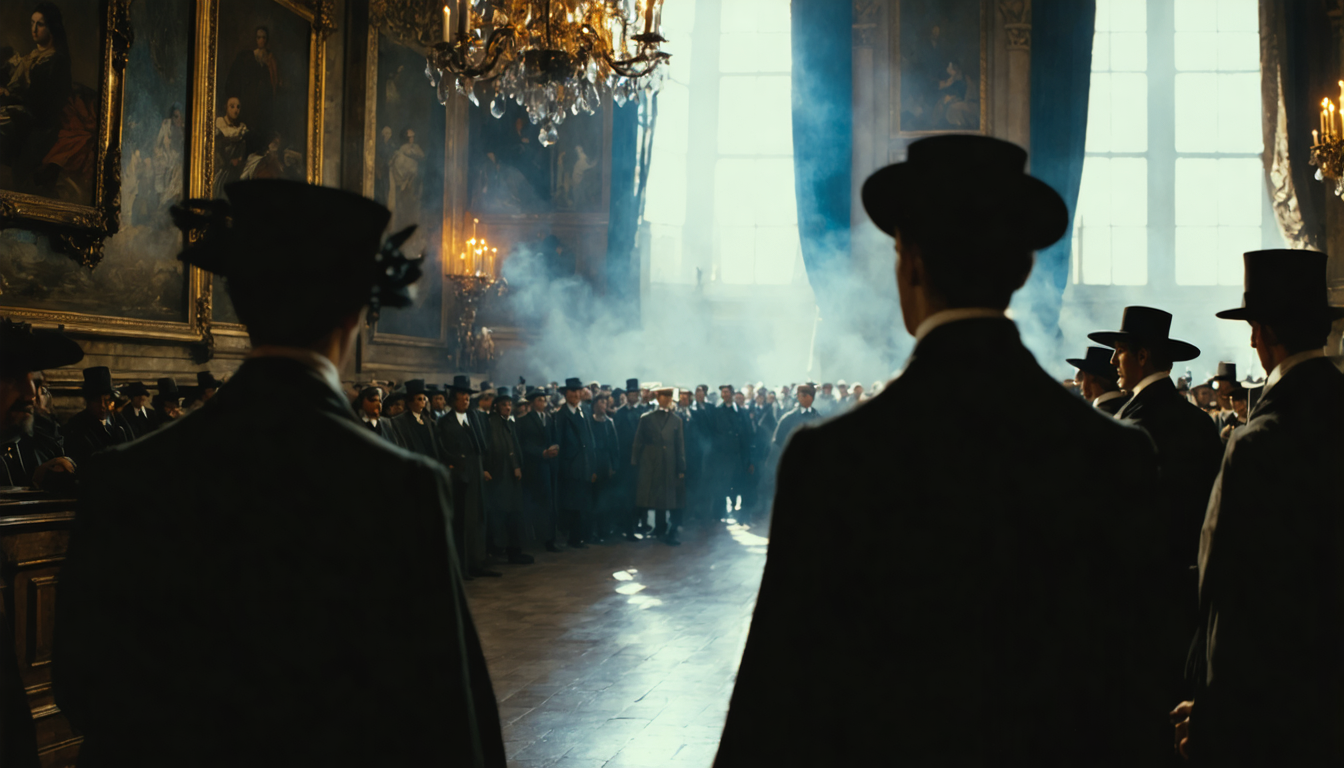
The game’s atmosphere is reinforced by the artistic direction. The settings blend Art Nouveau and Art Deco, but also surreal aspects, with exuberant and sometimes grotesque architecture recalling Bosch’s universe. The contrast between baroque beauty and the latent threat of disappearances creates a dark and captivating visual atmosphere, providing the perfect ground for a story that questions light and shadow as much as human bonds.
The 3D representation of Lumière in third-person invites exploration of every alley, every workshop, every cultural scene, enhancing immersion in this universe that is both retro and experimental. Added to this is a soundtrack and sound design that capture the vibrations of the era while adding oppressive fantastic tones. This mix is essential to fully immerse the player in this ephemeral and fragile Belle Époque.
An interesting aspect of this dystopian setting is how it questions the fear of time and the fight against fate. Society in Clair Obscur has integrated the limitation of lives to 33 years as a normal fact, but this triggers multiple human behaviors: from rebellion to resignation, passing through the heroic attempt to defy the inevitable, embodied by Expédition 33. It is precisely this contrast between acceptance and struggle that fuels the dramaturgy and emotional tension throughout the game, enhancing the weight of the scenario.

The “Gommage” phenomenon: a powerful metaphor between erasure and mortality
The “Gommage” phenomenon is at the heart of Clair Obscur: Expédition 33. It is a concept heavy with symbolism but also a narrative mechanic that paces the game’s development. Every year, when the number inscribed by the Peintresse on the monolith decreases, the lives of inhabitants are shortened and those who reach this fateful age are “erased.”
Practically, Gommage means that individuals disappear completely, not only physically but also from all collective memory. It is a total eradication that triggers deep anxiety in the characters and the player. This notion of erasure goes beyond simple death to touch on absolute oblivion, a disturbing nihilistic idea rarely exploited in video games.
From a narrative point of view, Gommage imposes a constant dramatic limit. By imposing such a short and declining maximum lifespan, the game installs a morbid suspense. Each character has an expiration date, influencing their choices, relationships, and motivations. This temporal pressure shapes poignant narrative arcs where sacrifices and regrets are omnipresent.
The Gommage mechanic also transcends gameplay: the fight against this phenomenon is the driving force behind Expédition 33, the central team in the game. The mission of these six protagonists is to stop this infernal cycle, but the solution is not simple, and everything is done so that this quest leaves the player with heavy moral and existential questions.
To better understand this phenomenon, here is a list of the major implications of Gommage in the game’s universe:
- Complete erasure: physical and memorial disappearance, making it impossible to remember the “erased.”
- Progressive reduction: every year, the age limit decreases, intensifying social pressure.
- Impact on human relationships: the proximity of ages limits lasting relationships, fostering a climate of urgency and emotional intensity.
- Discouragement and rebellion: some groups accept fate, others rebel or join Expédition 33.
- Manifestation of the Peintresse: this entity is responsible for the phenomenon, embodying control and manipulation.
Delving deeper into the symbolic approach, Gommage appears as a reflection of the battle between permanence and loss in art, memory, and human existence. It draws a parallel with ephemeral artistic works and the anxiety of lost remembrance.
The characters of Expédition 33: profiles, developments, and revelations
At the core of the story, Expédition 33 gathers six individuals with distinct backgrounds and traits, each bringing a unique dimension to the narrative thread. This diversity allows for a rich dramaturgy, where human interactions play a key role in understanding the painted world and its mysteries.
Here is a detailed presentation of the members of Expédition 33:
| Name | Role in the expedition | Characteristics | Personal development |
|---|---|---|---|
| Gustave | Charismatic leader | Mechanical arm, military experience | Protector of the team, struggle against fate |
| Maelle | Young protégé | 16 years old, courageous | Veil over her real identity, intense emotional burden |
| Lune | Enigmatic mage | Flying, barefoot, mysterious | Keeper of secrets, spiritual guide |
| Sciel | Agile fighter | Loss of a child, traumatized | Fights with her scars |
| Verso | Mysterious character | Key to the scenario, calm | Discovery of true origins |
| Monoco | Silent colossus | Brute strength, pilgrim | Symbol of physical resistance |
Each character is used to enrich the story and embody the themes of grief, memory, and hope. Their relationships are at the heart of the emotion, notably around Maelle and Verso, whose bond hides a critical truth revealed late in the story.
This heartbreaking revelation adds a new layer of interpretation: Maelle is none other than Alicia, Renoir’s burned daughter, while Verso is the reincarnation of her deceased brother. The complexity of these secret identities enriches the scenario’s decryption and invites deep reflection on memory, remembrance, and the way art immortalizes those we love.
The key revelation: a painted world by Renoir and its philosophical implications
Probably one of the most powerful and innovative narrative elements in Clair Obscur: Expédition 33, the discovery that the entire universe is actually a painting by Renoir radically shifts the perspective of the story. This twist, improbable but beautifully executed, moves the narrative from a simple RPG to a meditation on art, creation, and the pain of grief.
Renoir, an emblematic figure in this fictional context, constructs this painting in an attempt to resurrect his son who died in a devastating fire. Through his art, he also seeks to heal his daughter Alicia, burned on the face. The Peintresse, initially seeming antagonist, is revealed as a manifestation of his pain, a symbolic agent of the artist’s creative and destructive process.
This decryption opens fascinating avenues of analysis on the role of the artist as creator and destroyer, master and prisoner of his work. The painted world alternates between life and erasure, like a reflection of Renoir’s emotional and psychological instability.
To better understand this duality, here is a comparative table of the identities in the game and the real ones behind the painting:
| Character in the painting | Real identity | Relationship |
|---|---|---|
| Maelle | Alicia | Daughter of Renoir, burned in the fire |
| Verso | Deceased son | Alicia’s brother |
| The Peintresse | Manifestation of Renoir’s sorrow | Symbolic force, not human |
| The Faceless Child | Soul of the real Verso | Maintains the existence of the painting |
This revelation invites an interpretation of the game as a form of interactive cinema, where the dramaturgy is guided more by the emotional and symbolic thread than by simple playful progression. The line between magical realism and human tragedy blurs admirably in this narrative.
Deep interpretation of the final dilemma: reality versus illusion in Clair Obscur: Expédition 33
The ending of Clair Obscur: Expédition 33 imposes a heart-wrenching choice on the player, symbolizing a major philosophical conflict between painful truth and refuge in illusion. After confronting the ghosts of his past, Verso discovers a faceless child, the incarnation of his soul trapped in the painting.
The final confrontation between Verso and Maelle— or Alicia — highlights the tension between accepting death and loss or clinging to an alternative reality where everything still seems possible. This opposition touches on universal existential questions about the nature of life, memory, and hope.
Choosing Verso’s ending means embracing reality, however cruel it may be. The epilogue shows a family reunited by the son’s grave, soothed by the acknowledgment of loss. This conclusion, though tragic, offers a form of redemption and inner peace. It is a bittersweet proposition that values the courage to face the truth.
Conversely, opting for Maelle’s ending means remaining a prisoner of the alluring but unstable illusion. The idyllic opera scene, seemingly perfect, slowly cracks, revealing the fragility of happiness founded on lies. This reading emphasizes the dramatic tension inherent in the very act of denying reality.
This dilemma offers a richness of interpretation rarely equaled in interactive cinema or video game dramaturgy. It reflects the creators’ desire to tackle demanding philosophical questions, inviting players to reflect not only on the scenario but also on their own relationship with truth and escapism.
The two endings of Clair Obscur: Expédition 33 – analysis of consequences and symbolic scope
The endings of Clair Obscur are essential to grasp the narrative and emotional complexity of the game. They represent two opposing visions of the characters’ destiny and their world, affirming the multiplicity of possibilities and the relativity of happiness.
Here is a comparative analysis of the two major endings:
| Ending | Description | Consequences | Symbolic scope |
|---|---|---|---|
| Verso’s ending (“good” ending) | Acceptance of reality and grief | Family reunited by the grave, peace achieved | Courage, truth, sacrifice |
| Maelle’s ending (“bad” ending) | Denial of reality, choice of illusion | Idyllic world that cracks, final rupture | Illusion, escape, fragility |
These conclusions show that the game refuses simple solutions. It is not a linear triumph but an invitation to weigh the burden of pain against illusory comfort, with all the human consequences that follow.
The cultural and cinematic impact of Clair Obscur: Expédition 33 in the French landscape
Since its release, Clair Obscur: Expédition 33 has established itself as a major cultural phenomenon, transcending the simple framework of a video game. Its rich narration and complex dramaturgy have attracted the attention of critics, academics, and even French cinema. Several analyses have highlighted the way the title explores themes rarely addressed in this medium, notably grief, memory, and permanence through an artistic lens.
In 2026, the game is frequently studied in film and game design schools for its original narrative approach. Its status as a masterpiece is also confirmed by its ability to combine dynamic gameplay with a dense and deeply human scenario.
The Clair Obscur series has sparked several discussions about how video game dramaturgy can rival traditional cinema’s. It highlights the growing interest in hybrid works, where the player becomes an actor of the dramaturgy, directly influencing the narrative construction.
These cultural exchanges testify to the rise of French video games on the international stage, notably thanks to its independent studios like Sandfall Interactive that prioritize innovation and artistic quality.
Gameplay strategies and tips for an immersive experience in Clair Obscur: Expédition 33
To fully enjoy the dramatic intensity and fine scenario decryption of Clair Obscur: Expédition 33, here are some strategies to adopt:
- Play in an appropriate atmosphere: Choose a calm, dimly lit environment, with quality headphones to capture all the sound and musical richness.
- Take the time to explore: Don’t rush through the adventure. Enjoy the detailed settings and dialogues to understand the subtleties of the scenario.
- Analyze visual clues: Observe the settings and aesthetic choices that often reveal hidden information about the dramaturgy and universe.
- Experiment with both endings: Replay the game to discover all the implications of the final choices and enrich your personal interpretation.
- Engage with the community: Participate in forums and debates to share your analyses and discover different perspectives.
These tips contribute to a complete experience where gameplay and scenario intertwine harmoniously, revealing the full depth of this French masterpiece.