
Since its release in 2019, the film Joker has established itself as a disturbing and captivating work that transcends the simple framework of a superhero movie. More than mere entertainment, it offers a dark dive into the troubled depths of the human psyche through the chaotic journey of Arthur Fleck, a complex character masterfully portrayed by Joaquin Phoenix. Gotham City, far from being just a backdrop, becomes here a microcosm of a fractured society, where violence and marginalization intertwine until exploding into a desperate revolt. This film thus raises a multitude of questions about our own relationship to social violence, mental health, and the place of marginalized individuals.
In this context, it is essential to closely examine the story of the character Arthur, explore the motives that transform him into the Joker, and decipher the way director Todd Phillips weaves implicit social criticism within a streamlined narrative that resonates powerfully with our contemporary concerns. This analysis also aims to shed light on the psychological richness of the character, the symbolism of the makeup and narrative elements, as well as the implications of such critical and commercial success on superhero cinema and society in general.
The portrait of Arthur Fleck: a broken clown in search of identity and recognition
Arthur Fleck is much more than a simple villain or antagonist: he embodies a deeply human being, ravaged by neurological and psychological disorders. From the first minutes of the film, we discover a man marked by uncontrollable laughter, a symptom of a rare neurological disorder that heightens his social isolation and inner suffering. This detail is not insignificant, as it crystallizes the character’s difficulty in existing in a world that does not understand him and rejects him. Laughter, supposed to be a sign of joy, here becomes an instrument of misery, forcing Arthur to mask his distress behind a mask — literally that of the clown.
His daily life in a gloomy Gotham is a series of failures and brutalities. He works an ungrateful job, street clown, and regularly suffers unprovoked attacks. Ridicule and solitude follow him everywhere. The contrast is striking between his intense desire to become a recognized comedian and the reality of his miserable existence. The example of his imaginary relationship with his neighbor Sophie perfectly illustrates this fracture between his desire for intimacy and the coldness of the outside world.
Moreover, Arthur depends on a minimalist social support system, which provides him with a superficial social worker and insufficient medication. The film sharply depicts the decline of public services and the abandonment of the most vulnerable—a theme still burning in 2026. This administrative dehumanization symbolizes the forgetfulness of the marginalized. Arthur is not simply a suffering individual; he becomes a symbol of institutional exclusion, a textbook case of societal disinterest in mental health.
Ultimately, the character of Arthur Fleck blurs the boundaries between victim, perpetrator, and symbol. His fragile appearance and touching aspirations evoke a paradoxical empathy, while his emaciated body and disturbing laughter create an atmosphere of unsettling strangeness. This unstable balance is the key to his complexity and narrative power.
Arthur’s transformation into the Joker begins after a series of traumatic events that catalyze the shift from victim to aggressor. The first violent act is the murder of three Wayne Enterprises employees in the subway, verbally and physically assaulting Arthur. This scene illustrates the daily brutality endured by those marginalized by society and represents a decisive turning point. The weapon, introduced by a complicit colleague, becomes the vector of long-repressed rage.
This passage is not just an act: it embodies a social rejection that revels in the anonymity of the city. Arthur does not choose violence out of despair, but because he has no more room, no more ways out. Far from a traditional hero, his violence is an almost mechanical response to systematic harassment, a contained explosion revealing deep cracks in Gotham’s social fabric.
The retaliation from Thomas Wayne, the billionaire businessman and potential father figure, further worsens the fracture. By labeling the murderers “clowns,” he issues a social judgment that draws the attention of the dispossessed and sparks a collective revolt. Wayne’s categorical rejection of Arthur during a confrontation forces the character to seek his truths in the dark corners of his past, notably the discovery of his adoption and the abuse suffered as a child. These revelations shatter his last emotional certainties.
Here is a table simplifying the chain of events and their deep impacts:
| Triggering event | Impact on Arthur Fleck | Social consequence |
|---|---|---|
| Attack in the subway | Assumed passage to violence | Start of the revolt of the marginalized |
| Discovery of adoption and abuse | Loss of identity landmarks | Deep personal crisis |
| Public humiliation by Murray Franklin | Final slip into madness | Social explosion and chaos in Gotham |
In this context, each incident is a link in a fatal chain, the representation of a city sick with growing inequalities. Arthur embodies both the trigger and the metaphor of a revolt that transcends the individual.
Observing this succession of events, it becomes clear that the film establishes a very strong parallel between personal traumas and social dysfunctions. Arthur’s violence is not a simple call to fear but an illumination of the abuses that plague our contemporary era.
The symbolism of the makeup and the construction of the Joker character
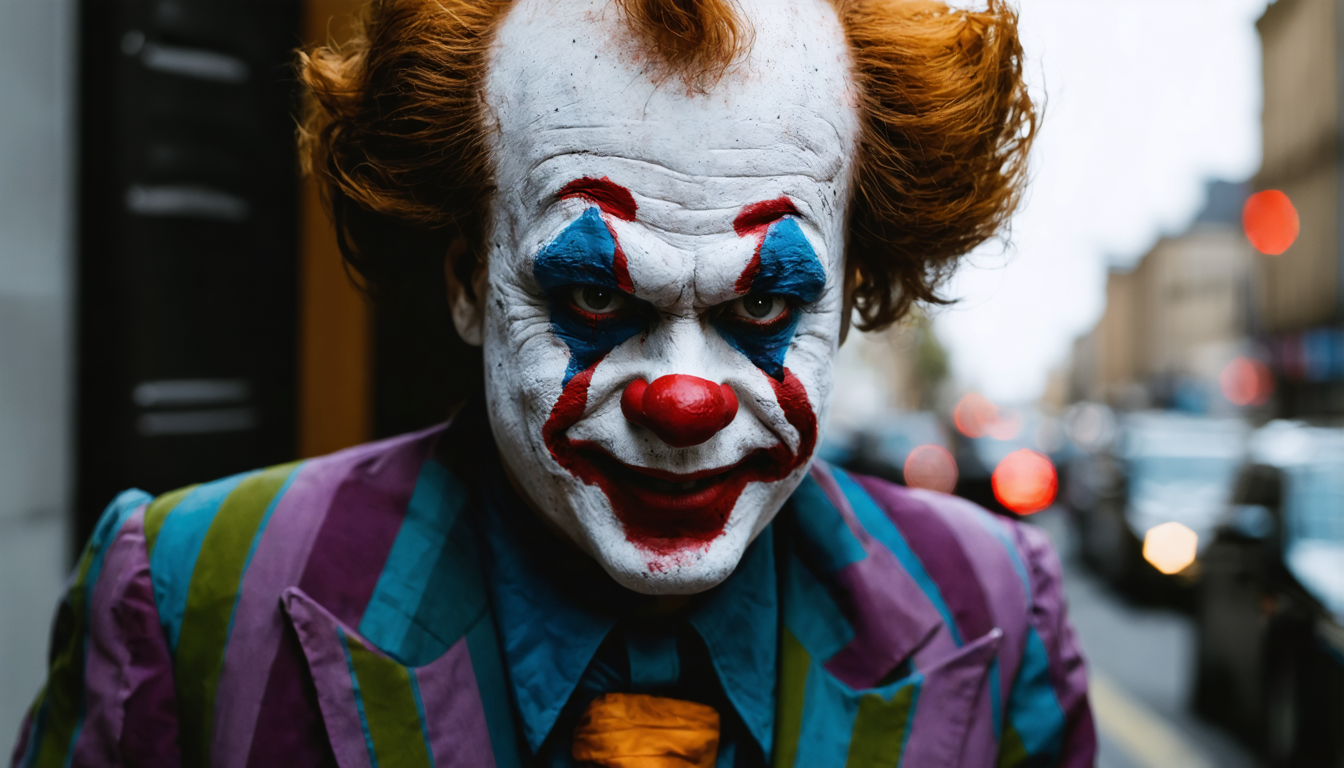
The makeup itself, iconic and immediately recognizable, is much more than a simple disguise. It becomes a liberating mask and a visual weapon. By covering his face with white paint, with an exaggerated red smile and blue eyes, Arthur transforms his appearance into a chaos icon, unrecognizable to those who sought to ignore him.
The choice of this makeup recalls the faces of traditional clowns, an ambiguous figure oscillating between childlike joy and hidden menace. This contrast perfectly reflects the double life of the character and his internal struggle. The physical metamorphosis accompanies the mental one: Arthur is no longer a helpless man but becomes a symbol of radical disobedience, an image gaining power by mobilizing the collective imagination of the marginalized.
The ritual of painting in several scenes marks a cathartic moment. When Arthur looks at himself in the mirror after applying his makeup, it signifies acceptance of his new role, the abandonment of illusions of normality. This visual passage is essential to understanding the progressive construction of the Joker, a figure never devoid of a certain psychological complexity.
Here is a list of the symbolic functions of the makeup in the film:
- Mask of anonymity: Allows Arthur to dissociate from his life of suffering.
- Instrument of fear: His transformation unsettles and imposes a feeling of insecurity.
- Expression of revolt: The makeup becomes the visible sign of his rejection of norms.
- New identity: Creation of an invincible alter ego that demands respect.
This transformation is also a defense mechanism against a world that denies his existence. The film, in 2026, continues to be praised for this very nuanced representation, which clearly distinguishes it from the usual clichés of bad guys in mainstream cinema.
The exploration of Arthur Fleck’s psychology is at the heart of the film. Todd Phillips does not merely show a violent man; he creates a complex portrait of a being teetering between mental illness and identity construction. The neurological disorder at the origin of his uncontrollable laughter is a poignant metaphor for his emotional state: a suffering he cannot express verbally.
Exacerbated solitude, institutional abandonment, and childhood abuse create unstable ground. This accumulation of trauma gradually triggers psychosis, until the definitive break with reality. Arthur’s madness is not only a loss of reason but a reaction to a hostile and indifferent environment. The film excels in portraying this infernal descent without falling into simplistic pathos or sensationalism.
To better understand this trajectory, it is useful to dissect the key stages:
- Social marginalization: isolation due to his disorders and rejection by society.
- Despair and fantasies: his imaginary relationship with Sophie illustrates this mental escape.
- Outbreak of violence: the subway incident symbolizes the break.
- Distorted self-awareness: discovery of his violent and betrayed past.
- Incarnation of the Joker: acceptance and adoption of his chaotic identity.
This progression, slow but inexorable, gives the character a rare psychological depth within the genre. It also allows the viewer to grasp the human complexity behind the archetype of the “villain.”
Most critics in 2026 agree that the film opened a new field for the representation of mental disorders in cinema, far from cynical caricatures. It invites reflection on the necessity of a more attentive and preferably benevolent society.
The central role of society and marginalization in the Joker narrative
Beyond the individual story, the film Joker functions as a sharp social critique, exploring the mechanisms of exclusion that push individuals to marginality and sometimes to violence. Gotham is not just a fictional city; it is a distorted reflection of many modern metropolises where inequalities deepen and essential public services are often powerless.
The cold depiction of budget cuts in mental health illustrates this abandonment. Arthur loses his social worker, his medication, and with it, a part of his dignity and self-control. This results in a progressive break with reality and an increase in violence. The film thus portrays a dangerous spiral that intensifies when society refuses to intervene effectively.
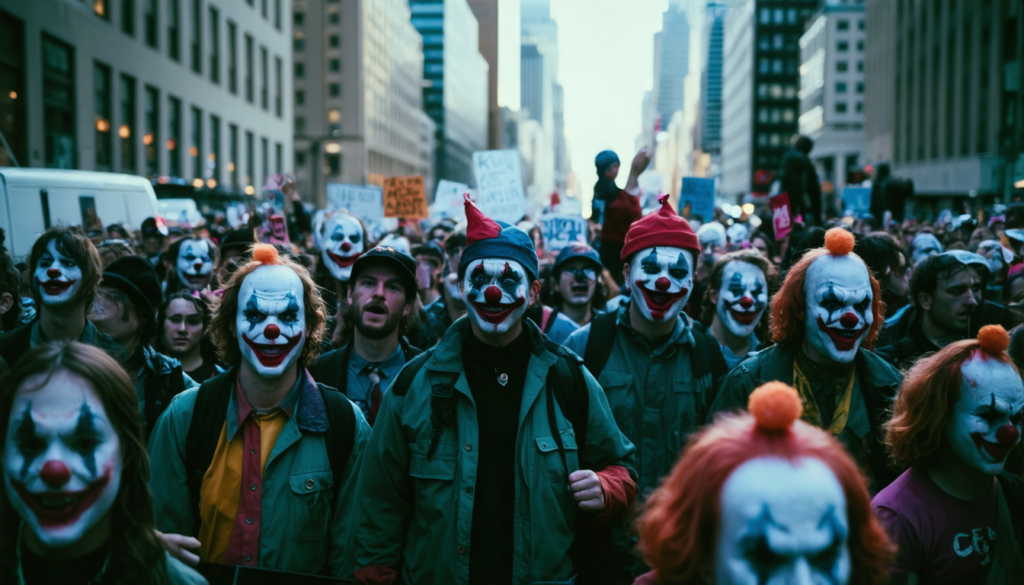
The protests and riots punctuating the end of the film embody the collective rage of the dispossessed, reinforcing the idea that the Joker is more than an individual: a symbol of a broader crisis. The clown figure, triggered by Thomas Wayne, paradoxically becomes a banner for a protest mixing despair, anger, and social demands.
This dynamic fits into a broader context, in which the issue of social fractures and latent malaise in large contemporary cities has intensified over the years. In 2026, debates about the place of the excluded, mental health care, and urban violence remain more relevant than ever, making the film an object of ongoing reflection.
Here is a summary of the main social themes addressed in Joker:
- Institutional abandonment of the mentally ill.
- Social exclusion and rejection of the marginalized.
- The rise of violence as an expression of contained rage.
- Growing tensions between social classes in Gotham.
- The role of the media in representing the excluded.
Critical reception and cultural impact of the Joker film in 2026
Upon its release, Joker left a lasting mark on cinema and popular culture. The film won the prestigious Golden Lion in Venice and earned Joaquin Phoenix the Oscar for Best Actor, while composer Hildur Guðnadóttir received the Oscar for Best Score. With more than 5.6 million admissions in France alone, the commercial success was immense despite passionate debates.
Some praised the immersive direction, the depth of the character, and the social critique, while others criticized the film for its sometimes nihilistic approach and the way it presents women, often relegated to secondary roles or victims. These critical discussions contribute to a real dialogue around the film and question its overall message.
The film’s success also influenced superhero cinema, encouraging a shift towards more psychological and social narratives, less centered on spectacular action. Joker sparked discussions on the use of violence in cinema and its potential impact on audiences—topics that remain highly relevant in 2026 in a world sensitive to ethical issues.
A table of major awards and the film’s commercial success:
| Awards and distinctions | Year | Significance |
|---|---|---|
| Golden Lion | 2019 | Major critical recognition at the Venice Festival |
| Oscar for Best Actor | 2020 | Praise for Joaquin Phoenix’s outstanding performance |
| Oscar for Best Score | 2020 | Distinction for Hildur Guðnadóttir’s immersive soundtrack |
| 5.6 million admissions in France | 2019-2020 | Massive commercial success |
These achievements clearly illustrate the multifaceted impact of the film, which transcends the boundaries of cinema to engage with contemporary societal and cultural debates.
Narrative continuity: Joker: Folie à deux and the evolution of the myth
In 2024, the sequel Joker: Folie à deux extended the exploration of the character by introducing a major new element: Harley Quinn, portrayed by Lady Gaga. This musical version with a darker tone examines the notion of “folie à deux” (shared madness), illustrating the complex dynamic between Arthur and Harley, two figures deeply linked in their mental and social decline.
The film deepens Arthur’s psychology while presenting a different path, where he eventually rejects the very identity of the Joker. This betrayal leads to his rejection and assassination in Arkham Asylum, opening the way to a possible new incarnation of the Joker, embodied by a young inmate with a chilling smile. This narrative evolution renews the myth and addresses the age gap issue between Bruce Wayne and Arthur Fleck.
This renewal of the character testifies to the myth of the Joker’s ability to adapt and reinvent itself without ever losing its symbolic power. The film questions the very nature of identity and psychological legacies, suggesting that the Joker is more than an individual, a generative force in a universe always in tension.
The Joker film as a critical mirror of our time: violence, marginality, and nihilism
Ultimately, the strength of the film Joker lies in its ability to reflect and question the deep ills of our society. It is not simply a story of individual madness but a corrosive analysis of social failures, notably the abandonment of the mentally ill, the rise of inequalities, and the violent resurgence of collective resentments.
Violence is not glorified but presented as a tragic consequence. Through Arthur Fleck, we discover the human and desperate dimension of this violence, a true “silent scream” of an invisible individual. The underlying nihilism, where social codes are pulverized, questions the limits of civilization and the role of empathy in preventing tragedies.
This film demands necessary reflection: how can a society face its own demons? Joker becomes then a universal work, both a psychological drama and a form of artistic protest.
To summarize in a list the fundamental questions raised:
- What place remains for the fragile in a ruthless world?
- How does marginalization feed social violence?
- Can laughter be a weapon or a warning cry?
- Is society capable of hearing those it excludes?
- How far can nihilistic expression go without losing everything?
These questions make Joker a work that surpasses its status as a supervillain movie to become a disturbing and fascinating mirror of our time in 2026.