
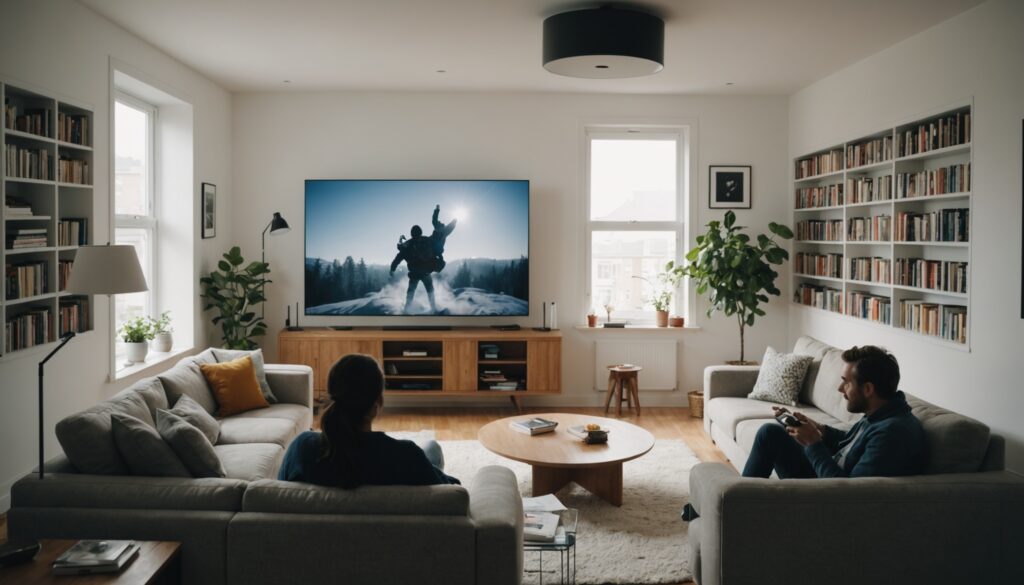
In the world of home entertainment and professional presentations, the projector has become an essential device. But to fully enjoy its potential, it is crucial to understand how to choose the right brightness according to your environment. Brightness, expressed in lumens, is often the first characteristic considered, but it requires careful and contextualized interpretation. Intrinsically linked to image quality, luminous power determines not only the sharpness but also the visibility of the video projection in the presence of ambient light. In 2026, with constant technological evolutions and user needs, accurately assessing the appropriate lumen quantity for your bright screen and light environment can transform your audiovisual experience.
Environmental constraints vary depending on whether you use your projector in a darkened living room, a room with moderate ambient light, or a brightly lit office. This choice is also closely related to the size of the projected screen and the main usage: home cinema, gaming, professional presentations, or outdoor. The projector budget also plays a role, especially when opting for different technologies such as LED, laser, or traditional lamps. Each solution affects color vibrancy, lifespan, and especially the realistic level of brightness achievable.
This detailed analysis will guide you step-by-step in exploring the essential factors to consider to choose a projector with the best quality/price ratio, targeting the right amount of lumens according to your specific setup. Moreover, you will discover how to balance brightness with other fundamental aspects such as contrast, resolution, and latency, to create a faithful, immersive video projection suited to 2026.
Understanding the meaning of lumens and the ANSI measurement in projector brightness
Before purchasing a projector, it is essential to familiarize yourself with the notion of lumens, this unit that quantifies the emitted light. At first glance, one might think that a high lumen number necessarily guarantees a bright, high-quality image. However, the reality is more nuanced. The lumen measures the total luminous power projected in a precise direction, but not all lumens are equal as they are not measured according to the same standards.
For this, the ANSI lumen is the essential reference. Standardized by the American National Standards Institute, this measure guarantees an objective and reproducible evaluation of projector brightness by testing the light on a surface at a given distance, taking contrast into account. The ANSI standard thus eliminates marketing approximations and allows effective comparison of different models.
For example, a projector displaying 3000 ANSI lumens delivers a constant and reliable luminous power, while a device boasting 5000 lumens without ANSI specification could artificially inflate its number by uncertified methods. This distinction is crucial to avoid unpleasant surprises when projecting video, especially in a bright environment where luminous power is paramount.
Furthermore, another subtlety arises from the fact that the projected light does not behave like the brightness of an LED screen on a smartphone or computer, which emits light directly to the eye. Here, the projector emits light towards a bright screen or wall, which then reflects it. As a result, the perceived brightness also depends on the nature and gain of this surface as well as the amount of ambient light.
A fine understanding of this technical unit will therefore help you better choose your projector, balancing the quantitative (number of lumens) and qualitative (ANSI standard) in the context of your light environment. This approach avoids the common mistake of buying a projector that is too weak for a bright room or, conversely, an oversized, over-budget model for use in a dark room.
Adapting projector brightness according to your light environment: practical advice
The main criterion for choosing the luminous power of a projector is the light environment in which it will be used. A dark room necessarily requires a lower lumen quantity, whereas a brightly lit office or outdoor space will demand a much more powerful model. This adaptation optimizes image quality and visual comfort, while maintaining contrast and readability.
Here is a summary table to help you determine the right brightness based on your context:
| Type of light environment | Recommended ANSI lumen quantity | Typical use |
|---|---|---|
| Dark room or dedicated home cinema | 600 – 2000 lumens | Movie projection, film nights |
| Living room with dimmed light | 2000 – 3000 lumens | Movies, video games in the evening |
| Partially lit room (semi-open shutters) | 2500 – 3500 lumens | Daily use, meetings, gaming |
| Bright offices, meeting rooms | 4000 lumens and above | Professional presentations, classes |
| Outdoor projection in broad daylight | Minimum 4000 lumens | Outdoor events, terrace evenings |
Through my experience, I found that a 1800 lumens projector was ideal in my cinema room plunged into total darkness: blacks are deep, image quality impressive, and the whole does not tire the eyes. Conversely, as soon as the room brightens a bit more, it is necessary to automatically increase the lumen quantity to maintain sufficient visibility and a nice bright image on the luminous screen.
It is also imperative to take screen size into account: projecting on a diagonal larger than 80 inches requires amplifying luminous power because light disperses over a larger surface. A classic mistake is using a low-lumen model for a large screen, which makes the image pale and poorly contrasted, as I experienced during a gaming session on a 120-inch screen with only 2000 lumens. The image was barely visible, completely ruining the experience.
Finally, the characteristics of your projection surface are important. A screen with a gain greater than 1 better reflects light, thus increasing the effective perceived brightness. Investing in a good screen can sometimes be more worthwhile than spending solely on a very powerful projector.
Screen size and expected luminous power: how to adjust your needs
The choice of projector brightness is closely linked to the size of the projected image. The larger the screen, the more intense the light must be to ensure a bright and well-contrasted projection suited to human perception. This is a key factor never to underestimate.
Each square centimeter of screen requires sufficient luminous flux for the image to be perceived clearly and without washing out. That is why, for moderate sizes between 60 and 80 inches, projectors ranging from 1500 to 2500 lumens are perfectly suitable in a dark environment. Once the diagonal exceeds 100 inches, it becomes necessary to consider models delivering at least 3000 to 4000 lumens, especially if ambient lighting is present.
There is no need to push luminous power to the extreme if you project small images in a dark room; it can even harm eye comfort with too aggressive light. The ideal is to find a compromise between screen size, ambient brightness, and luminous power.
To help you better visualize, here is a list of recommended adjustments:
- Screen under 80 inches, dark room: favor 600-2000 lumens.
- Screen between 80 and 100 inches, dimmed light: aim for 2000-3000 lumens.
- Screen larger than 100 inches, lit room: choose 3500 lumens and more.
- Outdoor or daylight projection: minimum 4000 lumens, regardless of size.
- Use a screen with gain >1 to improve perceived brightness.
This strategy guarantees an optimal balance between visibility, image quality, and eye strain. Don’t hesitate to measure the actual diagonal of your projection space before investing; it is a fundamental element that will directly influence the required luminous power.
How technology choice influences luminous power and durability
Beyond the simple lumen figure, the projector technology significantly impacts image quality, its consistency over time, and energy efficiency. In 2026, the main options on the market are LED, laser, and traditional lamp projectors. Each has specific advantages and limitations in terms of projector brightness and cost.
LED devices are renowned for exceptional durability and low energy consumption. Ideal for home use in a dark or dimmed room, they nevertheless offer limited luminous power, generally below 2000 lumens. This technology is often favored for small portable projectors because it combines compactness and autonomy, but it will be insufficient in a bright environment.
Laser projectors, on the other hand, provide a constant, powerful, and stable brightness. Capable of reaching and even exceeding 4000 lumens, they are suitable for very bright offices, classrooms, and intensive use. Their cost is higher than classic lamp models, but their longevity and faithful color rendering justify this investment for professional use.
Traditional lamp systems deliver a wide range of brightness, from 1000 to 6000 lumens or more. They remain a benchmark for professional installations and high-end home cinemas. However, their equipment requires more frequent maintenance and a gradual decrease in luminous power over time.
Thus, technology choice is conditioned by your projector budget, usage, and light environment. For example, a nomadic gamer will favor a compact LED projector despite the limitation in lumens, while a company will choose a robust, bright laser projector for frequent meetings in bright rooms.
The ideal lumen quantity according to your use: home cinema, gaming, and office
Before any acquisition, it is important to precisely identify your main use, as this parameter will strongly influence the choice of adequate luminous power. Each activity has its specific requirements to offer an optimal qualitative experience.
For home cinema, generally performed in a dark or darkened room, the ideal range is between 1500 and 2500 lumens. This calibration ensures excellent contrast and rich colors without disturbing night vision. The goal here is to create an immersive atmosphere close to movie theaters, where image quality takes precedence over simple luminous power.
Gamers have slightly different expectations. Latency and refresh rate become determining criteria, sometimes more important than the number of lumens. Thus, a projector delivering between 2000 and 3000 lumens, combined with a low response time, will suit most indoor gaming setups. It is crucial to properly adapt brightness according to gaming hours: at night, even a low lumen number is sufficient, while playing during the day requires more luminous power to counter ambient light.
Finally, in a professional context, notably for office use, the need for lumens is higher. Presentations must be visible even in broad daylight or in very bright offices. It is recommended to opt for projectors showing between 4000 and 6000 lumens, or more for large rooms. This prevents any frustration during meetings or classes, where ambient light cannot always be controlled.
Here is a summary list to guide you:
- Home cinema: 1500-2500 lumens, dark environment.
- Indoor gaming: 2000-3000 lumens, low latency prioritized.
- Office and presentations: minimum 4000-6000 lumens for large visibility.
- Outdoor projection: 4000 lumens and more depending on ambient light.
Choosing according to use will allow you to avoid overinvesting unnecessarily in an overly powerful device or, on the contrary, an undersized model, and to obtain a faithful and pleasant video projection.
The role of contrast, resolution, and connectivity in projector choice
While projector brightness is a fundamental criterion, it is not everything. For an impeccable rendering and superior image quality, other sometimes neglected parameters must also be carefully considered.
Contrast plays a major role, especially in dark scenes. A projector capable of delivering high contrast produces deep blacks and prevents the image from seeming washed out even in a less dark room. This greatly improves the immersive experience, especially in home cinema.
Resolution directly impacts image sharpness. In 2026, it is now common to find Full HD or even 4K projectors at reasonable prices. A high-definition projector will provide more precise details, which is essential for gaming and movies, but also for presentations where texts must be readable.
Connectivity is also a key criterion. Explore the available options: HDMI inputs, USB, Wi-Fi, Bluetooth, compatibility with streaming sticks or consoles. A good projector must integrate easily into your digital ecosystem and offer maximum versatility.
Finally, consider latency if you are a gamer, as well as the device’s noise level, which can be annoying during prolonged use. These aspects, although secondary to luminous power, are the icing on the cake for a choice truly adapted to your needs.
Common mistakes to avoid in choosing luminous power for projectors
The quest for the perfect projector often encounters pitfalls related to a poor understanding of brightness. I have seen many people fall into common traps that affect the final quality and satisfaction.
First classic mistake: focusing only on a high number of lumens believing that “the brighter, the better.” However, this reasoning overlooks the importance of the light environment and can lead to unnecessary extra costs where 2000 lumens would suffice.
Second trap: neglecting the ANSI lumens standard, relying only on marketing numbers. Without this reference, you risk buying a projector that is less bright than expected, which will spoil your projections in a bright room.
Third common blunder: ignoring the effective screen size. Projecting on a large screen with an undersized projector causes a washed-out, poorly readable, and disappointing image.
Fourth mistake: forgetting to adapt projector technology to its use and budget. For example, choosing a small portable LED projector for daytime use is doomed to fail.
Finally, some users focus exclusively on brightness without considering the rest of the essential criteria (contrast, resolution, connectivity), which leads to an unbalanced purchase.
To conclude this section, here are five recommendations to avoid these mistakes:
- Precisely analyze your lighting environment before choosing luminous power.
- Always favor ANSI lumens for a reliable indicator.
- Calculate your screen size to adjust the number of lumens.
- Choose projection technology adapted to your usage.
- Evaluate all technical criteria beyond brightness.
The projector budget: how to find the right balance between brightness and price
In 2026, the projector market offers a wide range that suits all budgets. Nevertheless, finding the perfect balance between luminous power and price can sometimes seem like a real puzzle. The temptation is great to opt for a cheap projector promising many lumens, but image quality and durability often suffer.
The price of a powerful and bright projector depends on multiple factors: technology (LED, laser, lamp), resolution, contrast level, brand, and of course the number of ANSI lumens. A 1500-lumen LED model can be found between 300 and 500 euros, while a 4000-lumen laser projector intended for professional use will easily exceed 1500 euros.
According to your needs, here are some tips to optimize your investment:
- For home cinema use in a low-light room, favor a 1500-2500 lumen model with LED or lamp technology at a medium price.
- For versatile use with variable lighting environments, favor a laser projector around 3000-4000 lumens, which will ensure durability and image quality.
- For intensive professional use, do not hesitate to invest in a projector with more than 4000 lumens with good contrast and excellent connectivity.
- Avoid too cheap offers with uncertified lumens or without the ANSI standard.
Remember that brightness is just one component among others in choosing a projector. An affordable, properly chosen projector can offer very good image quality and remain functional for several years. In any case, take the time to compare according to the standard, user reviews, and expert recommendations.