
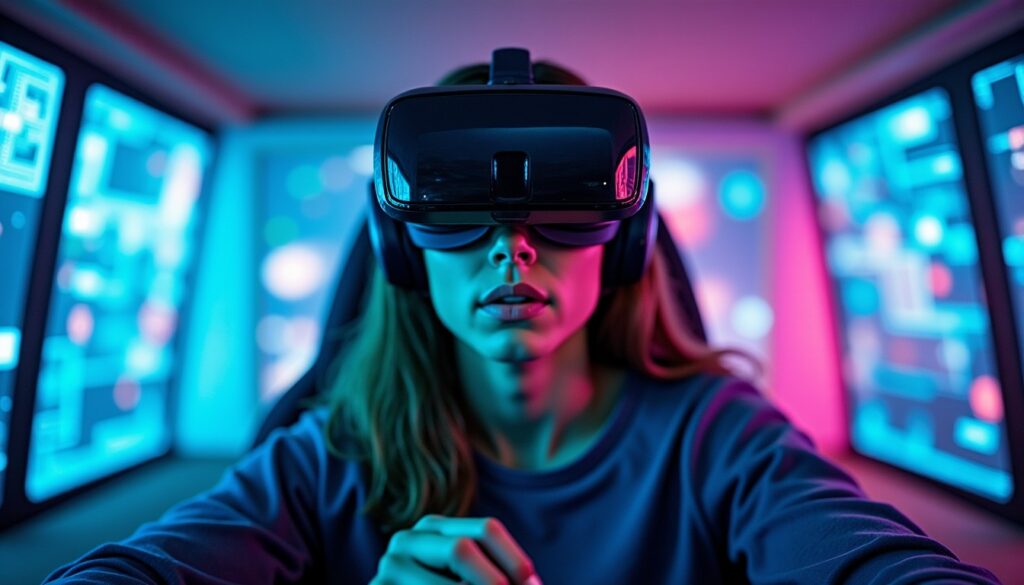
Since celebrating its 30th anniversary, the Evangelion franchise has continually pushed the boundaries of entertainment by integrating the overwhelming world of virtual reality. By blending the complex and symbolic universe of the anime with the most advanced immersive technology, Evangelion VR offers fans the unique opportunity to pilot an Evangelion, a true mythical mecha, fully immersing themselves in the cockpit called The Throne of Souls. This sensory journey, made possible by sophisticated devices, combines ultra-realistic simulation and deep storytelling, bringing Hideaki Anno’s epic to life from a new perspective. From Japanese arcades to home experiences planned for 2026, Evangelion virtual reality now crystallizes a major cultural and technological phenomenon.
The strength of this project also lies in its extreme fidelity to the anime, recreating not only the setting but also the palpable emotion through advanced interactions with iconic characters like Rei, Asuka, or Misato. Every detail is meticulously coded, from seat vibrations according to impacts to the manual management of resources such as the power cable or AT shields, plunging the player into a visceral immersion. Thus, Evangelion VR is no longer limited to a simple video game experience but becomes a truly rare-intensity simulation, enhanced by the narrative power of the franchise.
The revolutionary arcade experience: Evangelion VR The Throne of Souls in 2017
It all started in 2017 when, in the heart of Japan, first in Osaka then in Tokyo, Bandai Namco unveiled an arcade machine that would revolutionize the experience for Evangelion fans. Named Evangelion VR The Throne of Souls, this attraction combines virtual reality and physical movement in a cockpit recreated identically with almost obsessive precision. The player puts on an HTC Vive headset and takes a seat mounted on hydraulic pistons, capable of mimicking the shakes and shocks felt during a titanic battle against the 10th Angel, in the fictional city of Tokyo-3.
This immersive environment far exceeds mere aesthetics; the game mechanics encourage constant vigilance, just like in the original series. For example, the player must manage their power cable in real time to avoid disconnection, manually reload their weapons while deploying AT shields to block enemy attacks. This complexity adds a layer of realism and stress that overwhelms the pilot physically and mentally.
The scripted mini-sequences focus on the first 11 episodes of the series, providing a strong narrative alignment with the essence of Evangelion. The Berserk mode, introduced with the December 2017 update, enhances the experience by adding the EVA Mark.06, remixed metallic textures, and a blood-red colored interface when fury mode is activated. The whole is enhanced by the HTC Vive Pro headset, which offers a screen resolution of 2880 x 1600 pixels and extremely precise tracking thanks to Lighthouse technology.
This sensory and visual realism quickly made The Throne of Souls a must-have experience, acclaimed by franchise purists. However, it remains for now limited to Japan and specific venues, which fosters an aura of rarity and strong enthusiasm within the global community.
The XR Ride attraction: merging roller coasters with the Evangelion VR universe
Alongside this arcade revolution, another immersive experience named XR Ride was launched in Osaka in 2017. This attraction transforms traditional roller coasters into a true battlefield where every movement of the train is synchronized to the thousandth of a second with VR navigation through a modified Oculus Rift headset. This technological feat was developed through collaboration between Universal Creative and the Khara studio, ensuring complete coherence with the Evangelion universe.
The course extends over 585 meters inside a hangar towering 19 meters high, where visitors experience intense physical simulation. The seats vibrate using acoustic transducers, laser sensors detect real-time position to refine visual rendering, and industrial fans reproduce the sensation of wind caused by explosions or fast mecha movements.
This attraction attracts thousands of visitors daily, testifying not only to sustained interest in Evangelion VR but also to the unifying potential of experiences combining virtual reality and physical sensations. XR Ride is a vivid example of how the Evangelion franchise inspires innovations in immersive entertainment, creating a unique link between emotion and technology.
| Experience | Location | Technology | Main Features |
|---|---|---|---|
| Evangelion VR The Throne of Souls | VR ZONE Shinjuku, Tokyo | HTC Vive + hydraulic pistons | 4-player co-op, realistic cockpit, resource management |
| XR Ride | Osaka | Modified Oculus Rift | VR synchronized roller coasters, physical effects |
| Δ Cross Reflections (2026) | Home | Meta Quest 3 / PICO 4 | Mixed reality, planned trilogy, no microtransactions |
Evangelion VR: Δ Cross Reflections, the revolution of home virtual reality gaming
With the rapid evolution of standalone headsets and growing demand for immersive home experiences, the announcement of Evangelion VR: Δ Cross Reflections in 2026 marks a major turning point. Developed by the Korean studio Pixelity Inc. in partnership with GroundWorks, under the careful supervision of Studio Khara, this new game promises to completely revive the immersive experience previously reserved for arcades.
Compatible with Meta Quest 3 and PICO 4 headsets, both platforms integrating the latest Snapdragon XR2 Gen 2 processor, Δ Cross Reflections offers a smooth 90 Hz immersion without necessarily requiring a PC thanks to an optimized architecture. However, those wishing to enjoy enhanced graphics can use a Link cable to offload the rendering to a more powerful computer, providing welcome flexibility.
The initial content covers the first 11 episodes of Neon Genesis Evangelion and relies on the chronology of the Rebuild films, blending faithful storytelling with freedom of action. The player embodies an original protagonist learning to become a NERV pilot while interacting with iconic figures such as Rei, Asuka, and Misato Katsuragi. Choices and performance directly affect relationships and story development, giving surprising psychological depth.
A technical particularity of Δ Cross Reflections lies in its realistic resource management: the player must monitor their virtual power cable, reload weapons through manual gestures, and deploy AT shields by hand, generating constant tension similar to what Shinji experienced in the anime. Moreover, the city of Tokyo-3 has been carefully modeled, including destructible buildings and an advanced physics engine capable of handling collisions, enhancing the pilot’s total immersion.
The stakes of visceral immersion in the EVA Cockpit simulation
The immersive dimension of The Throne of Souls is not only due to its cutting-edge technology but also to the emotion conveyed by a simulation that approaches real sensations. Being physically transported into a cockpit recreated with extreme precision, amplified by moving seats and haptic controls, increases the feeling of embodiment in this colossal mecha. This visceral immersion is reinforced by the soundtrack, which works in perfect synergy with movements and narrative progression, creating an almost meditative experience in moments of tension.
An often overlooked aspect lies in real-time resource management, a system both technical and psychological. Keeping an eye on the power cable, responsible for maintaining the connection to the EVA, forces the player into constant multitasking. Manually reloading ammunition or activating AT shields demands fine coordination and precise timing, plunging the player into a permanent state of alertness similar to critical situations experienced by the anime characters.
This approach has a considerable impact on the human experience as it stimulates not only the senses but also cognitive and emotional capacities. It is impossible to remain passive or merely a spectator: every decision affects the flow of combat and the EVA’s condition. This demonstrates that the EVA Cockpit simulation goes beyond a simple gaming adventure to become a true psychological immersion, a deep dive into the existential issues dear to the Evangelion series.
The central role of narration and characters in Evangelion VR
At the heart of Evangelion VR The Throne of Souls and Δ Cross Reflections, narration holds a strategic place, far from mere mechanical confrontations. The emotional and human dimension is constantly present through interactions with key figures such as Rei Ayanami, Asuka Langley Soryu, or Misato Katsuragi. These dialogues, transcribed with the official Japanese voices and subtitled in French, enrich immersion by harmonizing anticipation, tension, and emotions.
Player choices influence relational progress with these characters, modifying certain storytelling elements and combat dynamics. For example, a strategic decision can lead to more active support from Misato or an intense psychological exchange with Asuka, impacting trust and coordination in the cockpit. This interactive dimension offers a new way of experiencing the anime, making each playthrough unique and personal.
This fusion between narration and gameplay represents a remarkable advance in anime video games, where fidelity to the source material combines with playful innovation to recreate memorable moments with renewed intensity. The game is not content to be a simulation: it becomes an interactive experience where the very identity of the pilot is built along the narrative.
Technical innovations at the heart of Evangelion VR simulation
The technological advances underlying Evangelion VR significantly contribute to its success and striking realism. The 2017 series of arcade machines, equipped with hydraulic pistons, offered unmatched physical simulation, with seats vibrating in perfect synchronization with player actions, culminating in the Berserk update which integrated EVA Mark.06 in fury mode. The use of the HTC Vive Pro headset, offering exceptional resolution and ultra-precise tracking thanks to Lighthouse technology, heightened the sense of presence.
In 2026, Δ Cross Reflections uses a cel-shading graphics engine faithful to the original anime’s aesthetic, allowing perfect visual immersion while maintaining high performance on Meta Quest 3 and PICO 4 headsets. Optimization for standalone wireless platforms marks a turning point that democratizes access to immersive Evangelion virtual reality, breaking hardware barriers and offering a smooth experience to a wide audience.
The technical details also include an advanced physics engine capable of handling real-time destruction of Tokyo-3 buildings, and thorough modeling of cockpits with interactive holographic interfaces. These innovations have raised the standard of VR simulation in the anime and video game sector, creating a benchmark model for immersive experiences with strong narrative impact.
Future prospects and the expansion of the Evangelion franchise in virtual reality
Looking to the future, the Evangelion virtual reality franchise shows no signs of slowing down. Studio Pixelity Inc. has already announced plans for a complete trilogy around Δ Cross Reflections, suggesting an increase in content and a deep exploration of Evangelion mythology through additional episodes. This structured development promises ever richer and more varied experiences for virtual pilots.
Moreover, the global community, very active despite the initial localization of arcade machines in Japan, eagerly awaits the democratization of these VR experiences at home. This anticipation creates strong enthusiasm around next-generation headsets, and the possibility of multiplayer connections remains an area to explore to strengthen social and competitive interactions.
The exceptional exhibition All of Evangelion, held until early 2026 in Tokyo, amplified this global interest by presenting an unprecedented collection of sketches, storyboards, and production-related items, highlighting the longevity and drawing power of the franchise. Thus, Evangelion VR stands as a cornerstone of contemporary Japanese animation and virtual reality, ready to write new chapters in immersive entertainment worldwide.
- Extreme faithfulness to the series and its characters
- Physical immersion thanks to advanced simulation technologies
- Realistic real-time resource management
- Varied interactive storyline influenced by player choices
- Exploitation of standalone headsets for increased accessibility
- Active and global community despite current geographic localization
- Constant innovation on technical and narrative levels