
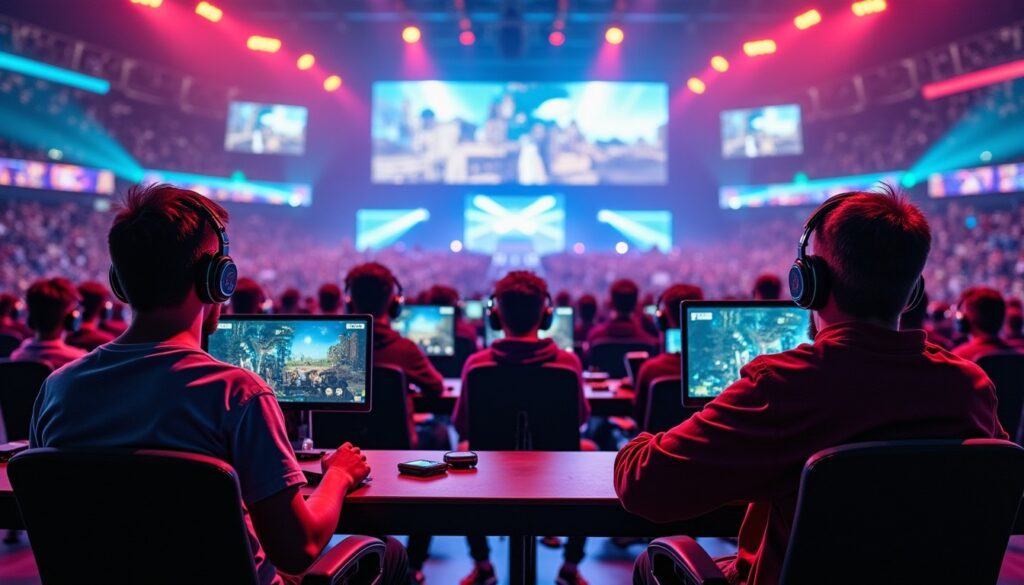
Once confined to small circles of enthusiasts, e-sports have broken beyond mere entertainment boundaries to establish themselves as a true global phenomenon in 2026. This sector, which combines performance, spectacle, and innovative technologies, fascinates millions of fans across the globe. It is not only the competition itself that attracts the audience but also the entire surrounding universe: from professional players to online communities, from streaming broadcasts to social networks, each aspect creates an immersive and collective experience. Major e-sports tournaments, now equivalent to the biggest traditional sports events, captivate as much as they excite and reveal significant economic, cultural, and technological stakes.
The spectacular evolution of e-sports is no accident. At the crossroads of video games and spectacle, it offers a unique space where exceptional talents express themselves, where historic rivalries are forged, and where emotions run intense, often even more than in classic sports. In 2026, e-sports events attract huge crowds to arenas, generate record audiences on streaming platforms, and inspire unparalleled engagement on social media. They have transformed the perception of video games, projecting a professional, sharp, and spectacular image that appeals to a new generation of gamers as well as to an eclectic, curious, and passionate audience. Discovering this universe means diving into a vibrant, dynamic culture, made up of technical challenges and powerful human stories.
The transformations of major e-sports tournaments: from garages to packed stadiums
Only about twenty years ago, the idea of filling an entire stadium for a video game tournament seemed unrealistic or even laughable. Today, major e-sports competitions are worldwide events, often held in arenas that can accommodate tens of thousands of spectators. These gatherings, transformed into grand spectacles, combine sophisticated lighting, scripted staging, and high-end streaming broadcasts, attracting an audience as wide as it is diverse. The image of the “gamer in a garage” has given way to that of genuine digital athletes under the spotlight.
The technical development of infrastructures has greatly contributed to this transformation. Live broadcasting via Twitch, YouTube, or other platforms has made tournaments accessible worldwide, even to audiences who have never stepped foot in a dedicated e-sports venue. For example, a League of Legends world final regularly gathers tens of millions of simultaneous viewers, doubling or even tripling the audiences of major traditional sports matches. This enthusiasm also manifests in the emotional dimension of the event, with fans connecting on social media to support their teams or simply share their passion in unison.
The organizers compete in ingenuity to offer a rich experience. Examples include:
- Spectacular opening shows incorporating pyrotechnics, live music, and augmented reality presentations.
- Professional commentaries often given by retired players or recognized experts, providing a sharp breakdown of deployed strategies.
- Interactive immersion promoted by dedicated applications where spectators can choose different viewpoints or participate in real-time polls.
This upscaling is a strong marker of the professionalization of e-sports, where spectacle is no longer an accessory but an integral part of the product. In parallel, the development of professional teams and organizations with solid contracts, rigorous training, and specialized services also explains the rising performance levels in these tournaments.
The emotional connection between gamers and competitors: a unique bond
One of the major strengths of major e-sports tournaments is this emotional closeness between professional players and their community. Unlike some traditional sports where spectators often have little intimate knowledge of the required skills, in e-sports, fans often master the games themselves. Simply having attempted competition on a game like Counter-Strike allows one to fully grasp the intensity of a successful clutch or a strategic teamfight.
This shared experience nourishes an immediate understanding of the stakes, fostering deep immersion in the spectacle. When a player executes a maneuver with extreme precision, it is an almost instinctive admiration that arises among spectators, inhabited by the memory and difficulty they themselves faced in their matches. This profound attachment is reinforced by the constant presence of players on social networks, in streams, or even at physical events where they can be met, strengthening the sense of belonging to a supportive community.
On the emotional level, the rising tension is often intense. During tight finals, the palpable tension on the streams triggers phenomenal collective reactions. For example, Team Vitality’s victory at the Counter-Strike Major sparked emotions equivalent to those experienced during a historic sports final. Communities react virally, sharing memes, clips, and analyses, keeping the event lively long after the competition ends.
E-sports, with its rhythm and interactivity, also enables the generation of immediate and raw emotion. The Twitch chat becomes a space of collective expression where spectators comment live, make their encouragements resonate, and live the suspense together. This immediacy phenomenon helps give the competition a unique character, making each match both a sporting and social ordeal.
The community, driving force and beating heart of e-sports tournaments
Beyond the competitors themselves, it is the gamer communities that constitute the true strength behind the rise of major e-sports tournaments. These groups, very active on Discord, Reddit, Twitch, and other platforms, form a dense and dynamic network that perpetuates enthusiasm and continuously enriches the competitive culture.
Discussions often begin well before the first official match: team compositions, recent transfers, player forms, probable strategies… Collective analysis is an activity in its own right, integrated as an essential dimension of the spectacle. This pre-heating phase captivates millions of fans, who invest as much in theory as in the practice of competitive video gaming.
Once the competition starts, interactions become even more intense. Communities gather to follow matches together, comment on actions in the streaming simultaneously, and exchange performance insights. They then recreate a sort of globalized lounge where each event becomes a major social moment remembered afterwards.
The importance of these communities is also expressed in their role as influencers: they participate in the massive sharing of clips, memes, or even iconic moments on social media, amplifying the impact and reach of the tournaments. These “viral” micro-contents are an integral part of the e-sports experience and help reach ever larger audiences, often outside the usual gamer circles.
Here lies one of the keys to the growing success of e-sports: a << participative culture >> where everyone can get involved according to their passion — from simple spectators to seasoned analysts, including content creators or commentators.
Performance at the heart of e-sports competitive stakes
What fascinates spectators in major e-sports tournaments is the exceptional level of performance deployed by professional players. Their ability to perform technical actions with extreme precision, make decisions within fractions of a second, or coordinate ultra-complex strategies often surpasses understanding for an amateur player.
Popular games like League of Legends or Valorant require an unprecedented combination of reflexes, mental endurance, and game reading. Players now train several hours a day in a professional setting with coaching, video analysis, and physical preparation. This rigor transforms e-sports into an activity closer to traditional sports than often imagined.
The strategic complexity of competitive video games is another factor of fascination. Each tournament reveals innovative tactical choices, metagame evolutions, and adaptations that make the competition rich and diverse. Deep knowledge of mechanics allows one to follow these evolutions in real time and appreciate the players’ creativity at its true value.
Here are the key components of e-sports performance:
- Ultra-fast reflexes to perform actions that seem impossible under normal circumstances.
- Precise and fluid team coordination, essential for collective success.
- Strategic anticipation to adapt one’s game plan in real time.
- Mental endurance to maintain concentration and composure for several hours.
The constant evolution of strategies also forces players and teams to never relax their efforts, perpetually seeking optimization and innovations. Each tournament is an opportunity to learn and progress in this highly competitive field.
The role of streaming platforms in popularizing major e-sports tournaments is undeniable. Twitch, YouTube, and other specialized channels have revolutionized how competitions are consumed in 2026. The immediacy and global reach allow reaching colossal live audiences who react and interact in real time.
Fans have access to a very rich palette of content around each event: official broadcasts, co-streaming by influencers, sharp analyses by former pros, or humorous commentaries, which greatly enrich the experience. Sometimes, certain viewers even prefer to follow their favorite creators’ reactions rather than the raw competition, helping diversify perspectives and build loyalty among varied audiences.
These platforms are also vectors for creation and dissemination of viral content. Short clips, highlight moments, memes deriving from the competition find on social networks an ideal playground, which amplifies the visibility and reach of e-sports.
Here are some notable impacts of streaming platforms:
| Aspect | Impact on e-sports tournaments |
|---|---|
| Accessibility | Instantaneous global broadcasting, accessible at any time |
| Interaction | Live chat, polls, real-time reactions |
| Content variety | Official broadcasts, co-streams, analyses, reactions |
| Virality | Massive creation and sharing of clips and memes |
These aspects make digital platforms an indispensable ally for the continued growth of e-sports.
Internet culture: a natural driver of e-sports tournaments
E-sports fit perfectly within the fast and interactive culture of the internet, which largely explains their immense popularity. Each match produces a continuous stream of clips, memes, and reactions that circulate instantly on social media. This ultra-shareable dimension gives tournaments a considerable viral echo whose reach far exceeds the initial framework.
The speed at which a spectacular action can become a viral phenomenon — an improbable clutch or an innovative tactic — greatly enhances the impact of competitions. Each tournament thus generates its ephemeral icons, its cult moments, its own narrative, which feed the collective storyline of the communities.
This phenomenon is reinforced by the younger generation, native to digital, which finds in e-sports a mirror of its culture and codes. The style of commentaries, the humor of memes, and the diversity of reactions in live chats make the event lively and decidedly contemporary.
Internet culture itself evolves in symbiosis with e-sports, where the codes of sharing, instant reactions, and interactivity are at the heart of the experience. In this context, tournaments benefit from organic promotion that is hard to match by other forms of competition or spectacle.
Analysis enthusiasts: an essential strategic dimension of e-sports tournaments
Within e-sports communities, a segment of enthusiasts stands out for their keen interest in fine analysis of matches and performances. These fans decode every strategy, examine statistics, compare team strengths, and even try to predict results.
This analytical dimension enriches the competition by providing a deeper and more technical reading of the events. Specialized platforms now offer advanced tools to follow players’ statistics in real time, visualize tactical choices, and understand evolving metagames during tournaments.
Analysts particularly appreciate:
- The detection of strategic evolutions that shape the game metas
- The study of individual performances through detailed data on accuracy, speed, and key decisions
- Historical comparison of teams and players to contextualize wins and losses
- Prediction based on trends before and during final phases
This analytical approach turns tournaments into true strategic laboratories where spectacle and reflection intertwine. It also stimulates the intellectual investment of spectators, strengthening their loyalty and engagement throughout competitions.
A promising future: growth, innovations, and new opportunities in e-sports
Despite its impressive achievements, e-sports is far from having reached its peak. In 2026, the sector continues to grow at an accelerated pace, driven by constant innovations, the arrival of new competitive games, and a diversification of formats.
Audiences, increasingly larger, push organizers to invest in ever more ambitious and sophisticated productions. Cash prize amounts are exploding, attracting talents from around the world and strengthening professional circuits. At the same time, the development of virtual reality, the rise of artificial intelligence in player preparation, and the integration of immersive technologies promise to profoundly renew both spectator and competitor experiences.
Here are some key trends to watch:
- Expansion into new video games and genres to diversify competitive scenes.
- Deployment of immersive technologies like virtual reality and haptics to boost engagement.
- Growing influence of social networks to co-construct tournament narratives with communities.
- Enhanced professionalization with more dedicated services for players (medicine, mental coaching, nutrition).
E-sports now fits into an exciting evolving dynamic, combining high-level competition, unique spectacle, and engaged communities that mutually enrich each other.