
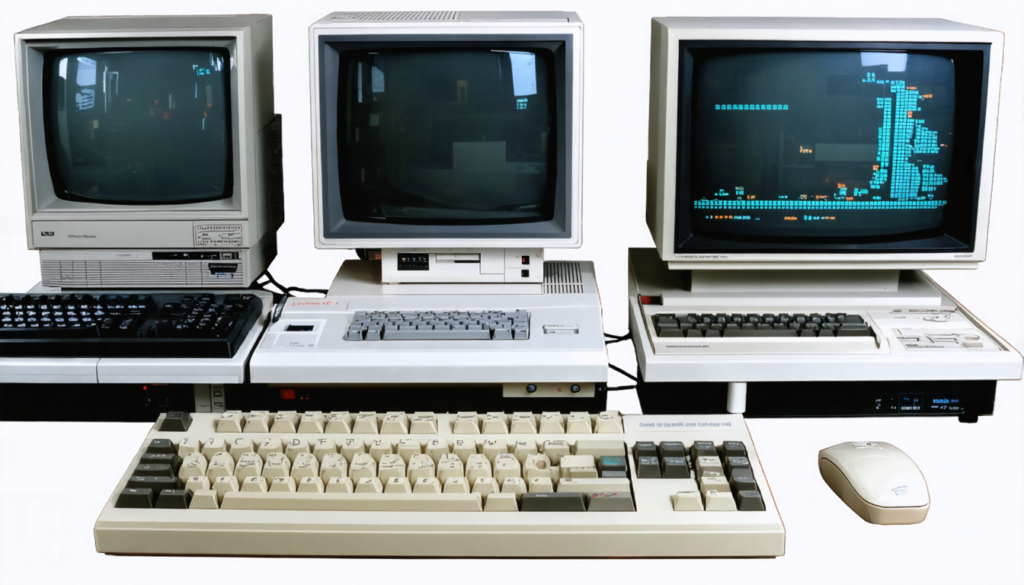
Let’s dive together into a true complete immersion at the heart of the year 1983, a fascinating period where innovation, cultural upheavals, and significant moments intersect. That year, history was written through memorable events that continue to resonate in contemporary culture. Whether one is interested in cinema, music, or technological advances, the secrets of 1983 unfold in a rich and captivating retrospective, awakening in enthusiasts a deep nostalgia for the 80s.
The year 1983 is not just a simple number; it is a true pivotal era. It is a period where cinema, music, and video games undergo major transformations, while computing initiates revolutions that will lastingly influence our daily lives, even in the connected world of 2025. Each sector forges an important part of the cultural and technological identity that still shapes many of our experiences today.
From the release of cult works on the big screen to the musical wave aiming to disrupt the codes, not to mention the upheavals in digital worlds and the rise of microcomputers, this dive into the year 1983 reveals unsuspected secrets to history buffs as well as pop culture curious. Throughout this in-depth analysis, you will discover how these landmark events not only punctuated that year but also laid the foundations for the decades to come.
Cinema in 1983: a milestone year in the history of the seventh art
The year 1983 is emblematic of 80s cinema, a true melting pot of masterpieces and narrative innovations. Among the most significant events of 1983, the end of a legendary trilogy: Return of the Jedi, the third installment of the Star Wars saga, captivates crowds by spectacularly concluding the adventures of Luke Skywalker, Han Solo, and Princess Leia. This film marks a major milestone in the history of science fiction cinema, blending avant-garde special effects and epic storytelling that still captivates modern audiences.
In another vein, 1983 witnesses the explosion of films with strong dramatic and criminal intensity. Scarface, directed by Brian De Palma and written by Oliver Stone, tells in a brutal and ambitious way the rise and fall of Tony Montana, played by Al Pacino at the peak of his career. This film symbolizes a dive into the gangster universe, with raw realism and a striking visual style, becoming since then an essential reference.
Suspense and horror also find their place thanks to John Carpenter, who adapts Stephen King’s novel with Christine, the story of a haunted car. This work perfectly illustrates the director’s talent for blending the fantastic with a tense atmosphere, and the film left a mark by its ability to make an inanimate object terrifying.
The year 1983 is also one of great change in France with the passing of the comedy monument, Louis de Funès. A true icon of the French stage, his departure leaves a huge void, but his legacy continues to make entire generations laugh. He alone embodies a prolific era of French cinema, where comedy held a central place in popular culture.
In retrospect, 1983 perfectly illustrates the diversity and richness of cinema. Between science fiction, drama, horror, and comedy, this year marks a turning point both in cinematographic techniques and in the way stories are told. The works of this period remain pillars of world cinema, studied and celebrated more than forty years after their release. Enthusiasts find in them a true source of inspiration as well as a complete immersion into the evolution of the most universal medium.

Major upheavals in the video game world in 1983
In 1983, the video game industry went through one of its most dramatic and instructive chapters. That year, a resounding crash occurred, putting the sector under severe strain, especially in the United States. This sudden crisis, known as the Video Game Crash (1983-1985), was largely caused by market saturation. Consoles multiplied: Atari 2600, ColecoVision, Intellivision and other machines flooded the market, but with often disappointing quality. Among these games, E.T. the Extra-Terrestrial on Atari 2600 is notoriously famous for being considered one of the worst titles ever produced, embodying both the rush and poor design that contributed to players’ dissatisfaction.
This technical and commercial crisis was not only attributable to consoles. The parallel emergence of microcomputers, such as the Commodore 64 or the ZX Spectrum, attracted a new generation of users seeking more varied and advanced games, which further diverted the public from traditional consoles.
As a direct consequence, the American market suffered a dizzying drop, from an enormous turnover of 3.2 billion dollars at the beginning of 1983 to only 100 million two years later, illustrating a nearly catastrophic decline of 97%. This situation completely redefined the rules of the game for actors in the video game field.
Salvation would come from Japan with the phenomenal success of firms Nintendo and Sega. Nintendo, in particular, will impose a revolutionary standard: the Seal of Quality. This certification guarantees players products meeting high standards, thus preventing the multiplication of mediocre games that had saturated the market. The Japanese firm left a lasting mark that year by releasing iconic titles like The Legend of Zelda and Super Mario Bros, the latter originally known as Jump Man.
On the French side, 1983 is not left behind with the birth of the distribution chain Micromania, which would significantly contribute to the structuring of the market and its democratization in the following years. This brand would play a key role in making video games accessible to the general public, laying the foundations of a specialized and passionate trade that persists today.
| Element | Description | Impact |
|---|---|---|
| Video Game Crash | Market saturation and poor game quality | American market drop from 3.2 billion to 100 million $ |
| E.T. Game (Atari 2600) | Considered one of the worst games | Symbol of the crisis, bad reputation of the sector |
| Microcomputers | Commodore 64, ZX Spectrum attract players | Shift of audience from consoles to computers |
| Nintendo Seal of Quality | Standard ensuring game quality on Nintendo | Revival of the global video game industry |
| Micromania | Birth of the distribution chain in France | Democratization and structuring of the French market |
Computing and decisive technological innovations of 1983
Beyond artistic creations, 1983 marks a major advance in the technological and computing field. That year notably witnessed the birth of an essential infrastructure for the rise of the web: the Domain Name System (DNS). Before this innovation, people had to remember complex numerical IP addresses to access websites. DNS drastically simplified navigation by allowing the use of clear and memorable domain names like Google.com. This invention was a turning point in the evolution of the global network, making access to online content much more user-friendly, a principle still fundamental in 2025.
In the software sphere, Microsoft launched in 1983 the first version of Word, a word processing software that quickly became a global reference. Even today, Word remains indisputably the leader in its field, supporting the efficiency of professionals and students worldwide.
Apple, for its part, hit hard with the release of Lisa, one of the first personal computers equipped with a graphical user interface (GUI) and a mouse. Although its high cost and some technical flaws made it a commercial failure, the Lisa served as a stepping stone for the iconic Macintosh that would revolutionize the way people interact with their computers. This period represents a complete immersion in the advent of the modern user interface.
The innovations of 1983 testify to a turning point in computing culture, laying bases that would evolve digital tools well into a hyperconnected world, far beyond the 80s. These periods of discovery continue to feed current fascination with technology, highlighting forgotten secrets that only enthusiasts can fully appreciate.

The music scene in 1983: hits, phenomena, and origins of icons
On the musical front, 1983 stands out as an emblematic year where several legendary artists take flight while others confirm their dominance. In France, the band Indochine enjoys resounding success with L’aventurier, inspired by the famous hero Bob Morane. Their new wave sound seduces a wide audience and lays the groundwork for a long and influential career in 1983 culture.
At the same time, the French rock band Téléphone continues to dominate the national scene with its raw energy and engaged lyrics, becoming an indispensable pillar of French music in the 80s.
Internationally, Michael Jackson reigns supreme. Released in November 1982, his album Thriller becomes the best-selling album of all time, amplified throughout 1983. The pop icon does not rest on his laurels: it is also during this year that he unveils his famous Moonwalk, an innovative dance which will leave a lasting mark on global music culture. His ability to blend music, dance, and video clips makes him a global superstar whose aura endures in 2025.
Another legend, David Bowie, shakes up his fans by releasing the album Let’s Dance, adopting a more accessible and pop style with worldwide success. Meanwhile, the Irish band U2 asserts its commitment with the album War, containing songs like Sunday Bloody Sunday and New Year’s Day, which combine musicality and a strong political message.
The musical diversity of that year is also manifested by the release of the debut albums of Metallica and Madonna. Metallica lays the foundations of thrash metal, a new and energetic genre, while Madonna begins her rise to fame, quickly becoming an unavoidable pop icon. This musical richness shaped the sound identity of the 80s and continues to inspire artists and music lovers worldwide.
- The emergence of emblematic French bands (Indochine, Téléphone)
- Michael Jackson’s global dominance with Thriller and the Moonwalk
- David Bowie and his change of musical style
- U2 and their political commitment in their songs
- The remarkable debuts of Metallica and Madonna
Major cultural events that marked the year 1983
The year 1983 is not limited to artistic and technological fields; it is the stage for a series of significant events in the global cultural sphere. These events reinforce the place of 1983 in collective memory and leave a lasting imprint on the construction of our modern society.
Cinema, music, and computing intertwine with events and releases that captivate audiences. For example, the release of innovative films or the emergence of revolutionary musical genres is accompanied by the progressive democratization of new digital technologies.
Artistically, numerous exhibitions and festivals, beginning with gatherings around rock and pop, illustrate both nostalgia and the desire to build a contemporary identity. Some countries adopt this transformation as a means of cultural affirmation facing the geopolitical stakes of the period.
On the socio-political level, 1983 sees protest movements relying on music and artistic expression to convey strong messages. It is also a moment of evolution where popular culture begins to integrate new technologies, thus preparing the digital era in which we live today.
This period is therefore an intersection where tradition and modernity mutually influence each other, illuminating how the 80s forged a foundation of references and emotions that persist among those who lived through that era and those who are still discovering it.
The year 1983 is also a key stage for the global economy, notably due to upheavals caused by technological and digital advances. These transformations deeply affect lifestyles as well as industrial and commercial structures, in the United States, Europe, and Japan alike.
The emergence of microcomputers like the Commodore 64 and ZX Spectrum transforms consumption and introduces a new era of learning and access to computing even at home. This democratization also impacts education, businesses, and households, creating an environment where mastering computer tools quickly becomes an essential skill.
The video game and consumer electronics industries also have to adapt to these changes, redefining their strategies in the face of saturation and crisis experienced by some markets like the American one. This phenomenon highlights the capacity of Japanese players, including Nintendo, to innovate and revitalize struggling sectors.
This technological revolution has major social consequences, notably on the creation of skilled jobs and the rise of a digital culture that would become predominant in the following decades. The software and hardware sectors generate a new class of entrepreneurs and developers, some of whose names remain synonymous with innovation and excellence today.
Finally, the appearance of DNS, a cornerstone in Internet development, opens unprecedented possibilities for commerce, communication, and culture, laying the foundations of a booming digital economy that increasingly connects the world at the dawn of the 21st century.
Icons and major personalities that marked the year 1983
The analysis of such a rich year as 1983 cannot overlook the emblematic figures who marked this period. Whether stars of cinema, music, or technology pioneers, these individuals embodied the spirit of their time and left indelible marks.
Louis de Funès, icon of French comedy, passed away in 1983, leaving an immense legacy. His exceptional career and unique style continue to make generations laugh and inspire successive ones.
In the musical field, many personalities either emerge or confirm their legend. Michael Jackson indisputably dominates that year with his album “Thriller” and the invention of the Moonwalk. David Bowie and U2 reinforce their stature with albums that resonate strongly with the public, while Madonna and Metallica embark on their careers, becoming symbols of musical and cultural innovation.
In the video game sector, figures like Shigeru Miyamoto, the creator of Nintendo franchises, lay the foundations of a gaming revolution that continues today. They embody the adaptability and creativity that saved an industry in crisis.
Finally, Steve Jobs, alongside Steve Wozniak, influenced the computing sector with innovations such as Lisa and Apple’s vision for personal computing, thus announcing the arrival of a new digital era that would disrupt usage in the years to come.
The links between 80s nostalgia and the lasting influence of 1983 today
The nostalgia for the 80s is a cultural phenomenon that intensifies in 2025, and this is largely explained by the major impact that years like 1983 had, not only on their time but also on our contemporary world. Understanding this nostalgia also means analyzing how existing elements in 1983 culture endure in current practices.
Classic films from that era are regularly revisited, adapted into series, or studied for their contribution to cinematic storytelling. The music remains indispensable classics, played at various events or covered by contemporary artists. Moreover, innovations in video games laid the foundations of modern interactive universes, still exploiting mechanics initiated in 1983.
Technologies originating from that year, starting with DNS but also user interfaces derived from Apple prototypes, have been progressively perfected, leading to the digital environment we know today. This technological and cultural continuity fuels a shared sense of identity, which enthusiasts affectionately call a complete dive into a past rich with secrets and lessons.
For enthusiasts and the curious, this retrospective of the year invites a lively and passionate rediscovery, where each element – from cinema to video games to music – tells a story and reveals a facet of the 1983 spirit.
Key events of 1983: major moments and their impact on the modern world
Finally, exploring the key events of 1983 allows grasping the decisive importance of this year over time. Whether technical advances, cultural events, or societal changes, each moment counts and gives meaning to the trajectory leading to today’s interconnected world.
Among other things, we recall the release of films like Return of the Jedi, which was a powerful mode of expression for the collective imagination, or the beginnings of revolutionary games heralding the future digital entertainment industry. Innovations like DNS or Microsoft Word opened new paths for communication and information sharing.
Beyond these advances, cultural movements born in 1983 continue to fuel contemporary artistic creation, while nostalgia for that era reflects a quest for authenticity and creativity in the face of the overwhelming technologies of our time.
The memory of 1983 is rich in teachings, and revisiting this year with a multidisciplinary vision is a true complete dive into a pivotal time in our recent history.