

As the digital age seeps into every aspect of our daily lives, the quality and performance of our internet connection become crucial issues. Whether you are a fan of high-definition video streaming, a passionate gamer looking to eliminate the slightest lag, or a professional telecommuting who needs a stable and fast connection, having a reliable tool to assess and optimize your internet speed is now a necessity. This is precisely what Degrouptest offers, a platform that became essential in 2026 for anyone wanting to master their online experience. Accessible without installation, this free tool provides an accurate measurement of your connection speed while informing you about the various network technologies available at your home.
Degrouptest does not just measure bandwidth: it performs a comprehensive diagnosis of network quality, revealing the real performance often hidden behind the commercial promises of internet service providers. Its intuitive interface helps you understand the results by distinguishing download speed, upload speed, and latency – essential parameters for assessing the smoothness of your browsing or the responsiveness needed for online gaming. Moreover, this platform offers detailed analyses by operator, allowing you to easily compare offers and choose the one that best suits your needs.
In a landscape where the rapid deployment of fiber optic still coexists with aging ADSL networks and where mobile 4G/5G is gaining popularity, Degrouptest combines both an ultra-precise eligibility test with comprehensive optimization tools, including an interactive map locating cell towers and local performance. Data enthusiasts will even find information on elements such as the NRA code or the mutualization point, key to understanding speed variations depending on distance and infrastructure. This complete overview makes Degrouptest an indispensable ally for anyone wishing to fully exploit the potential of their high-speed connection.
Test your internet eligibility with Degrouptest to secure your digital comfort
The first step to enjoying a high-performing internet connection often involves a clear answer about the network technologies available at your address. Degrouptest excels in this area thanks to its comprehensive eligibility testing system, which quickly indicates whether your home can benefit from fiber optic, ADSL, VDSL2, cable, or even wireless solutions like mobile 4G/5G. This tool is particularly valuable during a move or for those considering switching providers, as it allows a precise overview of accessible offers across all brands.
The test works in a very intuitive way: you simply enter your full postal address or your fixed line number to get a detailed analysis. Degrouptest’s algorithm simultaneously queries all the referenced operators’ databases, including Orange, Free, SFR, Bouygues Telecom, but also alternative players like OVH Telecom or Nordnet. The result, presented in distinct sections, includes the list of compatible technologies, available pricing offers, and a technical section rich in specific data such as the NRA code and the attenuation of your line.
This information is essential to understand why some connections work better than others. For example, in rural areas where fiber optic is not always deployed, mobile 4G/5G can be a viable alternative, especially with the technical advances of 5G in 2026, which often allow speeds exceeding 100 Mb/s under optimal conditions. Degrouptest thus offers not only an accurate snapshot of your current situation but also an overview of possible improvement prospects, including access to triple-play solutions, TV and internet, as well as offers for the connected home.
The technological section that Degrouptest reveals does not stop there: it also offers an interactive map that positions your address relative to major infrastructures such as cell towers or telephone exchanges. This geolocation is crucial because it partly explains performance differences linked to the distance from the mutualization point or the associated NRA code. This technical transparency allows you to better communicate with your provider in the event of a dispute over service quality.
List of information available via the Degrouptest eligibility test:
- Compatible access technologies (fiber, ADSL, VDSL2, cable, 4G/5G)
- Commercial offers and announced speeds for each operator
- NRA code and location of the mutualization point
- Information on attenuation and line quality
- Interactive map of networks and nearby antennas
Thus, with this approach, you secure your subscription choice and avoid disappointments linked to unfulfilled promises. This preliminary step is often decisive, especially in a country where internet coverage still varies significantly according to geographic areas.

Diagnose internet quality and performance with the Degrouptest speed test
With the speed test offered by Degrouptest, you move from theory to practice. It is not enough to know which technology is available: you also need to know the actual speed you get, thereby evaluating your connection’s internet performance on a daily basis. This test precisely measures download speed, upload speed, and latency (ping), three key indicators to understand how your internet connection will support your usage.
Download speed dictates how quickly you can download files, watch videos in HD or 4K streaming, or browse the web without interruptions. Upload speed is crucial for sending content activities, such as live streaming, sending large files, or telecommuting with document sharing. As for latency, expressed in milliseconds, it is the connection’s responsiveness that mainly matters for gamers or any real-time communication (video conferencing, VoIP calls).
A concrete example: on a fiber optic connection, the Degrouptest will show a speed often exceeding 600 Mb/s for downloads, with a ping under 10 ms, ensuring optimal smoothness. Conversely, on VDSL or ADSL, the results will be more modest, often around 20 to 200 Mb/s with variable latency that can reach 80 ms. For 4G/5G mobile networks, the perceived speed largely depends on your distance from the antenna, with average speeds around 110 Mb/s.
It is important to know the conditions under which this test is performed. A Wi-Fi test generally returns lower results than a test conducted over Ethernet, due to signal interference, walls, or the equipment used. Therefore, it is advised to use a wired connection to get an evaluation as close as possible to reality. Moreover, if you notice resource saturation on your machine (CPU at 100%), the Degrouptest analysis will help determine whether the slowdown source comes from your equipment or your internet speed.
To facilitate understanding of the results, here is a comparative table of typical performances according to access technology, updated for this year:
| Technology | Average Download Speed | Average Upload Speed | Average Latency | Recommended Usage |
|---|---|---|---|---|
| Fiber Optic | 600 Mb/s | 500 Mb/s | < 10 ms | 4K streaming, intensive gaming, telecommuting, cloud |
| ADSL / VDSL2 | 19-219 Mb/s | 2-5 Mb/s | 20-80 ms | Web browsing, SD streaming, light telecommuting |
| 4G/5G Mobile | 110 Mb/s (variable) | Variable | Variable | Mobile streaming, mobility, troubleshooting |
Degrouptest relies on nPerf technology, the French leader in bandwidth measurement, to provide users with reliable and consistent results complying with ARCEP standards. This precision makes it a recognized measurement tool for internet diagnostics.
Compare operator performances and offers thanks to Degrouptest
Another key feature of Degrouptest is its monthly bandwidth barometer, which allows comparing network quality of the main internet service providers: Free, Orange, SFR, and Bouygues Telecom. These regularly updated comparisons reveal often unsuspected gaps and help you choose an operator suited to your needs and geolocation.
For example, Free stood out in 2026 with an average fiber speed exceeding 700 Mb/s, a significant advantage compared to its competitors around 600 Mb/s. This difference results from the faster deployment of XGS-PON technologies across the territory. Conversely, in the 4G/5G domain, performances remain more fluctuating, conditioned by antenna proximity and network density.
Beyond raw numbers, these barometers also include indicators such as connection stability, packet loss rate, and customer service quality. These criteria are crucial for evaluating the overall user experience. Degrouptest thus provides global ratings that take all these factors into account.
Here are some of the key criteria analyzed in the Degrouptest barometer:
- Effective average speed by technology
- Connection stability by time and day
- Ping quality for real-time usage
- Customer service and incident management
- Geographical network coverage
This data provides a comprehensive view helping you rationalize your commercial choice and negotiate with your operator. Access to this information is all the more valuable as many consumers do not know the real network quality in their area and sometimes settle for promotional offers without assessing actual performance.
Use the interactive network map to visualize your internet coverage
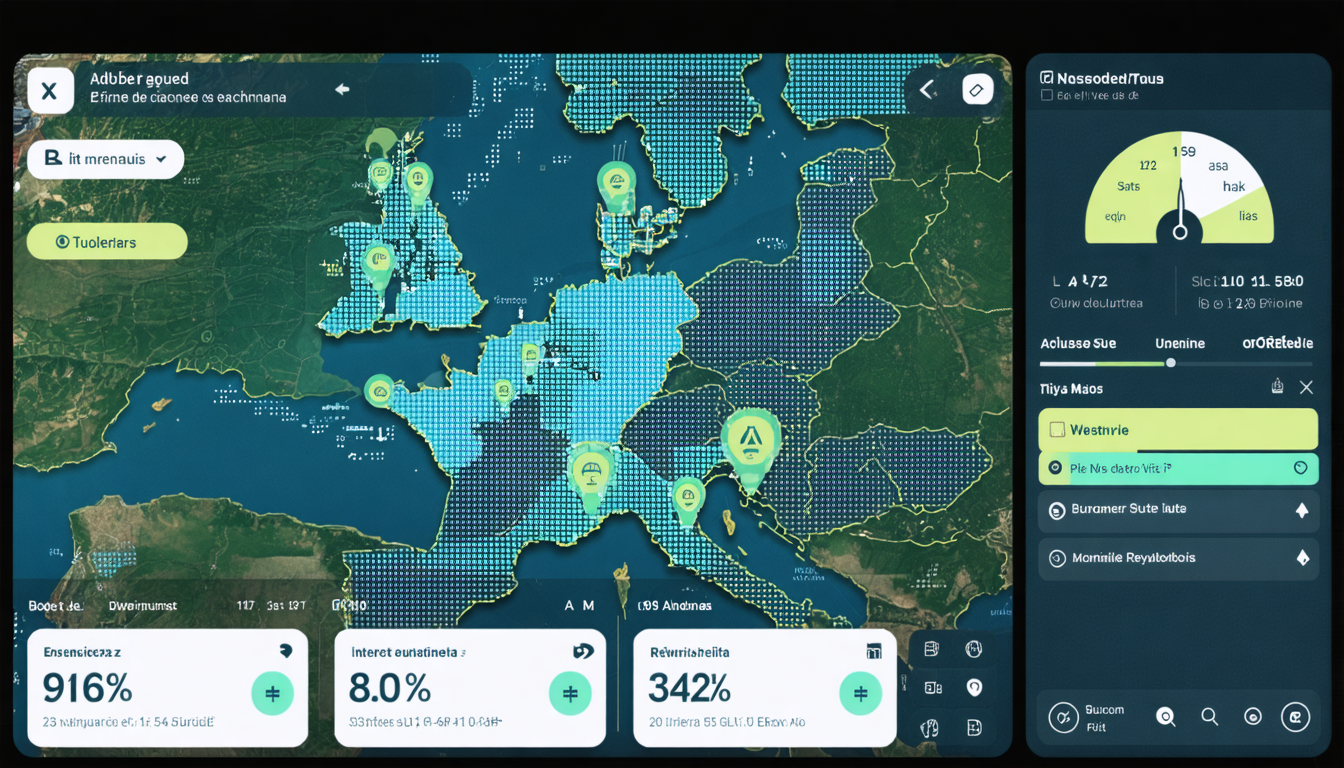
One of Degrouptest’s most appreciated services is its interactive network map, which lists and locates all cell towers and speed tests carried out across France. This geographic representation allows you to compare connection quality in your town and even your neighborhood.
This detailed, real-time updated map not only indicates the precise location of infrastructures but also the operators running them, the frequencies used, and even the straight-line distance between your address and the nearest antenna. Thanks to this, you can quickly identify white zones or underserved areas and know if future rollouts are planned.
For example, I personally used this map to orient my 4G box’s external antenna in a secondary residence located in Brittany. Result: a 30 Mb/s gain in my speed, a tangible improvement that reduces frustrations linked to streaming and teleworking off the fiber network.
This service is not only aimed at individuals: professionals can leverage these data to choose suitable installation sites, optimize company connections, or anticipate local network developments. The transparency offered by this interactive map fosters a better understanding of network quality and guides strategic decisions.
Leverage advanced technical data for fine optimization
For the most demanding users, Degrouptest offers access to advanced technical information, explaining in detail the origins of speed fluctuations and possibilities for personalized improvement. These data notably include the NRA code (the telephone exchange), line attenuation, the mutualization point, and the physical quality of the connection.
The NRA code is a fundamental element: it corresponds to the telephone exchange or the line aggregation point where your connection is attached. The distance between this point and your home directly impacts signal attenuation and thus your actual speed. The farther you are, the more your line will suffer losses and a quality drop. Fiber drastically reduces these effects, but in areas where it is not yet available, this data remains decisive.
Attenuation, for its part, measures signal loss due to distance or wiring quality. A heavily attenuated line will result in an unstable connection and low speeds. Knowing these parameters allows you to accurately diagnose the reasons for any slowdowns.
The mutualization point designates the place where subscriber lines interconnect with the operator’s network. Modern infrastructures facilitate better speeds and reduced latency. The information provided by Degrouptest also helps spot hardware malfunctions or saturation zones, giving a clear basis to request intervention or upgrades of your installation.
This technical transparency offers a precious advantage, especially during a call to customer service, allowing effective targeting of the problem and avoiding often frustrating generic diagnoses.
Practical advice to optimize your internet connection with Degrouptest
Internet connection performance does not depend solely on the provider or the technology used. Your home setup plays a major role. With Degrouptest, you can not only evaluate your speed but also easily track improvements after each adjustment. Here are some recommendations to make the most of your connection:
- Perform tests over Ethernet: Wi-Fi results are often less stable and weaker. An RJ45 cable provides a reliable and consistent connection.
- Restart your box regularly: a reboot can resolve many problems linked to memory and interference.
- Update your equipment: adopt recent standards like Wi-Fi 6 or Wi-Fi 7, which improve network quality by reducing latency and increasing capacity.
- Monitor off-peak hours: avoid usage peaks in the evening if possible, as network load impacts performance.
- Identify sources of interference: some electrical devices can create interference, affecting Wi-Fi connection quality.
After each modification, a test on Degrouptest can confirm the gains obtained or the stabilization of the connection. It is a valuable internet assessment tool that guarantees that your efforts pay off.
Understand the evolution of standards to anticipate your future needs
The world of high-speed connection is evolving rapidly, and Degrouptest keeps you informed about new technologies that will impact your online experience. From the advent of fiber optic infrastructures to the rise of fixed 5G and Wi-Fi 7 protocols, anticipating these changes is essential to avoid being left behind or dissatisfied in a few years.
The emergence of XGS-PON, which allows symmetrical speeds up to 10 Gb/s, is a game changer in urban areas, while fixed 5G is establishing itself as an alternative solution in still poorly covered zones. Furthermore, the popularization of Wi-Fi 7 protocols offers better management of multiple streams, a noticeable reduction in latency, and a significant improvement in coverage within modern homes.
Thanks to Degrouptest and its regular updates on operator offers and infrastructures, you can better plan your migration to these technologies, anticipating deployment near you. This continuous monitoring helps you avoid premature investment or delays in accessing optimal performance.
How Degrouptest revolutionizes the evaluation and optimization of your internet speed
At the heart of this digital revolution, Degrouptest positions itself as a true information catalyst and a facilitator for decision-making. Its open and free interface allows everyone, individuals and businesses alike, to perform an in-depth internet diagnosis, combining commercial, technical, and practical aspects.
The wealth of data combined with powerful visualization tools make Degrouptest a must-have for those seeking to regain control over their high-speed connection. With a few clicks, you can check your eligibility, measure actual internet performance, compare offers, locate key infrastructures, and apply necessary optimizations for a smooth online experience, whatever your usage.
As an informed user, you move beyond the role of a passive consumer to become a knowledgeable actor capable of dialoguing with your provider on clear grounds. In 2026, Degrouptest is no longer just a speed tester but a true strategic guide in the complex landscape of internet access.