
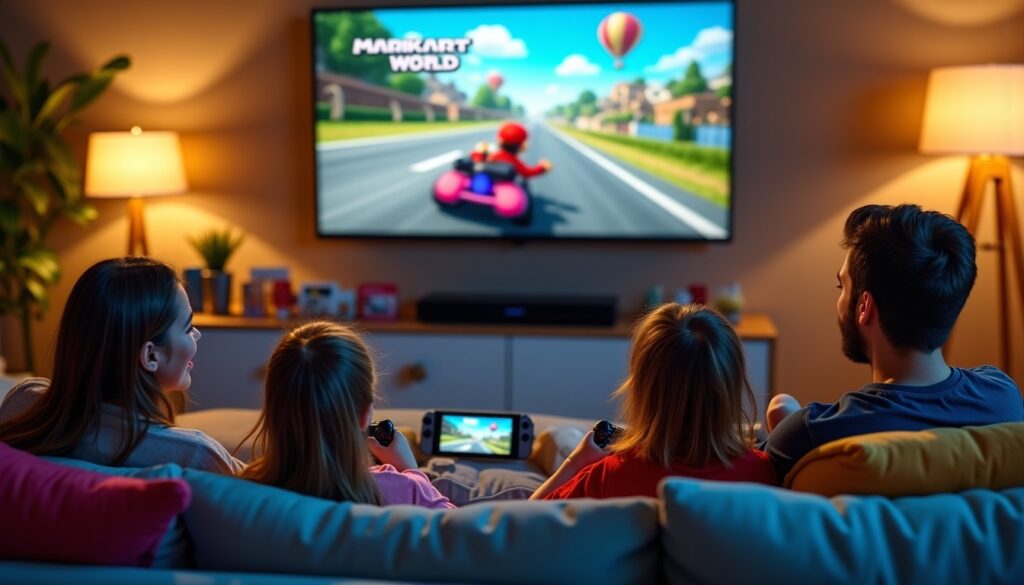
Since the reveal of the pricing for the highly anticipated Mario Kart World, the gaming community has been shaken by an unexpected announcement: the price of the game on the brand new Switch 2 console will be significantly higher than previous generations. This substantial increase raises questions among both Nintendo fans and video game market observers, sparking a passionate debate about price evolution and the perceived value of video game productions.
While the Nintendo Switch has always been praised for its excellent value for money and accessibility, this trend seems to be changing with the arrival of the Switch 2 and its first major titles. Mario Kart World, the flagship game intended for this console, is assigned a record price, yet accompanied by major innovations in its gameplay and universe, inviting an exploration of the reasons behind this pricing strategy. We will dissect in detail the arguments put forward by Nintendo, where this increase stands in the broader context of the video game market, as well as what this evolution means for players and the industry.
Mario Kart World and the unprecedented price increase on Switch 2: a historic turning point
The new Mario Kart World will be sold at €89.99 for the physical version and €79.99 for the digital version, a threshold never before reached on a Nintendo console. Until now, the price record was held by the highly acclaimed Zelda: Tears of the Kingdom, set at about 70 euros. This roughly 10 euro increase may seem modest, but it is actually a strong signal of a new era for the franchise.
This change in pricing policy occurs in a context where Nintendo intends to align its prices with the growing complexity and richness of gaming experiences offered, while taking into account the technical and creative investments necessary to create ever more ambitious titles. For players, this price reaffirms both the expected quality standards and raises the question of financial accessibility in the future.
But then, how does Nintendo concretely justify this increase to nearly 90 euros? And is this similar dynamic found among other major publishers in the industry? Let’s reflect on these questions by analyzing both the economic and technical factors shaking the video game sector in 2026.
Variable pricing explained by Nintendo: between innovation and investment
Doug Bowser, president of Nintendo of America, spoke out to clarify the justification behind this high price. According to him, Nintendo has implemented a variable pricing policy that adapts to the specifics of the content offered and its scale. This strategy, independent of mere marketing positioning, is based on several essential criteria:
- Human and financial resources invested in the development of the game, including creative teams, innovative technologies, and post-launch support.
- The depth of gameplay, with a fully explorable open world, hundreds of hours of possible playtime, and advanced mechanics requiring specific expertise.
- The estimated lifespan, to offer a lasting experience with additional content and varied multiplayer modes.
- Exceptional replayability, thanks notably to dynamic challenges and changing environments.
Bill Trinen, vice president of products, points out that this model allows for not freezing prices around an average but finely adjusting according to the value delivered to players. This approach is also meant to anticipate the expectations of the most demanding consumers while justifying the displayed amounts relative to the richness and durability of the experience.
This approach echoes strategies adopted by other giants of the video game industry, who modulate their pricing based on the ambitions of each production. However, for Nintendo, known for its desire to offer accessible games, this initiative represents a notable evolution, likely to change the economic landscape in which its fans operate.
Key new features of Mario Kart World influencing its price
The announcement of a price increase was not accompanied by a simple cosmetic update; Mario Kart World incorporates a set of innovations aimed at enhancing the gaming experience and partly legitimizing its higher cost. Among the key elements, Nintendo offers:
- A vast open world to explore freely, a first in the history of the Mario Kart series, combining exploration and racing for an unprecedented immersion.
- Races that can include up to 24 participants, nearly doubling previous capacities, which increases competition and social interaction during online matches.
- A dynamic weather system with real-time variations, as well as a day/night cycle impacting gameplay and race atmosphere.
- An innovative “Knockout” tournament mode where less performing players are progressively eliminated, increasing tension and suspense up to the final.
- An exploration mode that allows visiting and interacting with iconic environments from various Nintendo universes, enhancing the adventure and fan service aspect.
These features are not mere gimmicks but require advanced technical infrastructure and considerable creative work. For example, dynamic weather management involves complex programming to ensure effects vary each race while guaranteeing smoothness and realism.
The open-world mode, for its part, demands redesigned level design, complex scripts, and adapted artificial intelligence to integrate these new dynamics into the fast and explosive gameplay typical of Mario Kart. These technical challenges partly explain why the game price reaches a new high.
The impact of price increases on the Nintendo community and players
The record pricing of Mario Kart World has provoked mixed reactions among players. On one hand, part of the community expresses incomprehension towards this increase, fearing that the financial accessibility of video games on Nintendo Switch is compromised. For many, the Mario Kart series has always been synonymous with family entertainment at a reasonable price, reinforcing intergenerational bonds.
On the other hand, some more invested players believe that the quality and extent of innovations fully justify this cost, recognizing Nintendo’s efforts to push technical and creative boundaries. This duality thus raises a broader debate about the discipline of video gaming: between deep innovations requiring more resources, and the consideration of the average purchasing power of consumers.
Among the concerns expressed are possible disruptions in Nintendo’s economic model, notably the frequency of Switch 2 + game bundles, or the influence of higher pricing on the second-hand market and various resale platforms.
This situation invites reflection on players’ expectations in 2026, particularly in terms of balance between quality, price, and accessibility, as well as on the evolution of the relationship between a historic publisher and its loyal fanbase.
Bundled offers and their role in Nintendo Switch 2’s pricing strategy
Nintendo also offers a solution to limit the financial impact of this increase: a bundle including the Switch 2 console and Mario Kart World in digital form at a price of €509.99. This promotion is limited in time but represents a considerable advantage for new buyers, bringing the price of the game down to about €40 in this context.
This type of bundled offer is an effective strategy to encourage rapid adoption of the Switch 2 while bridging the gap between consumer expectations and the real cost of high-end productions. It also helps stimulate concurrent sales of consoles and games, contributing to creating a virtuous economic ecosystem.
For players already owning the first generation of Switch, Nintendo plans a reduced-price porting policy: Switch games compatible with Switch 2 will be offered at €9.99 for holders of the original versions, thus facilitating the transition without imposing a full expense.
This segmented pricing model, combined with occasional offers, underscores Nintendo’s willingness to adapt to different user profiles, from newcomers to longtime collectors.
| Product | Physical price | Digital price |
|---|---|---|
| Mario Kart World | €89.99 | €79.99 |
| Zelda: Tears of the Kingdom | €79.99 | €69.99 |
| Donkey Kong Bananza | €79.99 | €69.99 |
| Switch to Switch 2 game porting | €29.99 (for owners) | €9.99 (for owners) |
Economic analysis: why are video game prices increasing in 2026?
The upward trend in video game prices is neither unique to Nintendo nor exclusive to Mario Kart World; it reflects a global phenomenon affecting the industry for several years. The economic reasons behind this inflation are multiple and complex:
Firstly, the cost of developing ambitious games has exploded, incorporating cutting-edge technologies such as advanced 3D modeling, artificial intelligence, extended reality, and relying on often international multidisciplinary teams. These components require greater payroll and infrastructure.
Secondly, the market is moving toward longer and richer experiences, demanding longer production cycles and regular updates to retain players. This involves more post-release efforts, often included in the launch price or justifying additional fees.
Thirdly, competition, especially with mobile games and game streaming platforms, forces publishers to offer distinctive products, often more costly to produce. They aim to capitalize on a player base willing to invest in premium content.
Finally, general inflation and increased logistical and distribution costs also contribute to these price hikes, directly impacting the final price in stores or on digital platforms.
These combined factors illustrate why an experience like Mario Kart World, innovative as it is, is valued at a premium price, reflecting current economic realities while fitting into a new strategy for Nintendo.
What are the prospects for the future pricing of games on Nintendo Switch and Switch 2?
In 2026, the price increases may mark the beginning of a new era for Nintendo and the sector as a whole. This change requires players to approach their relationship with video games differently, juggling innovation, perceived value, and budget.
It can be envisaged that Nintendo, through these new price levels, seeks to strengthen the premium character of the Switch 2 and its catalog, while relying on bundled offers to maintain attractiveness. The challenge will be balancing profitability and player loyalty, at a time when digital competition is intensifying.
Moreover, the Mario Kart World experience could lay the foundations for a new franchise whose price will systematically reflect the complexity and richness of the proposed universe, similar to what is already observed with AAA productions on home consoles. This could also influence the pricing policy of future Nintendo games, forcing the community to revise its spending standards for video games.
Finally, with the rise of subscriptions and on-demand services, the question of an alternative economic model could soon become central: towards an offer allowing access to numerous titles for a monthly fee, or the growth of additional content purchased à la carte. Nintendo has already started this reflection, and the coming months promise to be exciting for the market.