
In the vast universe of Minecraft, juggling item enchantments has become an essential skill for any player wishing to optimize their gear. Whether it’s a sharp sword, a sturdy pickaxe, or a well-reinforced armor, enchantments provide essential bonuses that can transform your gaming experience. However, it often happens that an enchantment no longer meets your expectations or is simply a mistake along the way. Disenchantment then becomes crucial to regain control of your tools and armor, whether to start over or to better manage your resources and progression. Yet, Minecraft does not offer a direct method to remove an enchantment while keeping it, which raises many questions among players. Here, our practical guide offers a comprehensive overview of the available techniques to remove an enchantment from an item, taking care to untangle myths and realities about the current functioning of the most iconic open-world video game in 2026.
We will see how the grindstone, sometimes underestimated, stands as the only reliable recourse to effectively remove unwanted enchantments. Furthermore, we will explore alternative strategies to better preserve valuable enchantments or optimize their use on your tools and armor. Our journey will also include the best tips for obtaining enchantments via enchanted books and enchantment tables, as well as advanced methods to combine and repair your magical equipment without loss of efficiency. This practical guide is not limited to explaining simple mechanisms but aims to provide you with an in-depth understanding of the subtleties of disenchantment, to help you progress intelligently in Minecraft.
Understanding the functioning of disenchantment in Minecraft: the essential basics
At first glance, Minecraft may give the impression that removing an enchantment from an item is simple, but the reality is more nuanced. Contrary to what many novices may think, there is no vanilla mechanism allowing direct transfer of an enchantment from one item to another in the base game. Mojang, aware of the balancing implications, deliberately closed this door to preserve challenge and avoid over-facilitating optimization. This decision is fundamental to understanding why all disenchantment tips rely on the pure and simple removal of the enchantment rather than on its preservation.
The direct consequence of this rule is that when an enchantment is removed from an item — for example a pickaxe or a sword — that enchantment is permanently lost. In other words, you will have to recreate or find the same enchantment again from scratch, through enchanted books, a high-performance enchantment table, or other methods. This mechanism thus forces players to think twice before abandoning their enchantments, as they represent a significant cost in experience points and resources.
Another key point concerns curses, like “Curse of Binding” or “Curse of Vanishing,” which stick permanently to your items. These curses cannot be removed by grindstone, anvil, or any other valid method in vanilla Minecraft. Disenchantment therefore applies only to positive or neutral enchantments, which complicates equipment management even further. Players sometimes face difficult choices: keep a cursed item hoping to optimize its other enchantments, or replace it completely.
The disenchantment mechanic also fits naturally into the game’s progression, as it encourages exploration, trading with librarian villagers, and searching for the best combinations via the anvil. This design has its advantages for the durability of objectives but also imposes a certain learning curve. Understanding the limits and possibilities of disenchantment is thus the first step to succeeding intelligently in Minecraft.
The grindstone, an indispensable tool to remove an enchantment in Minecraft
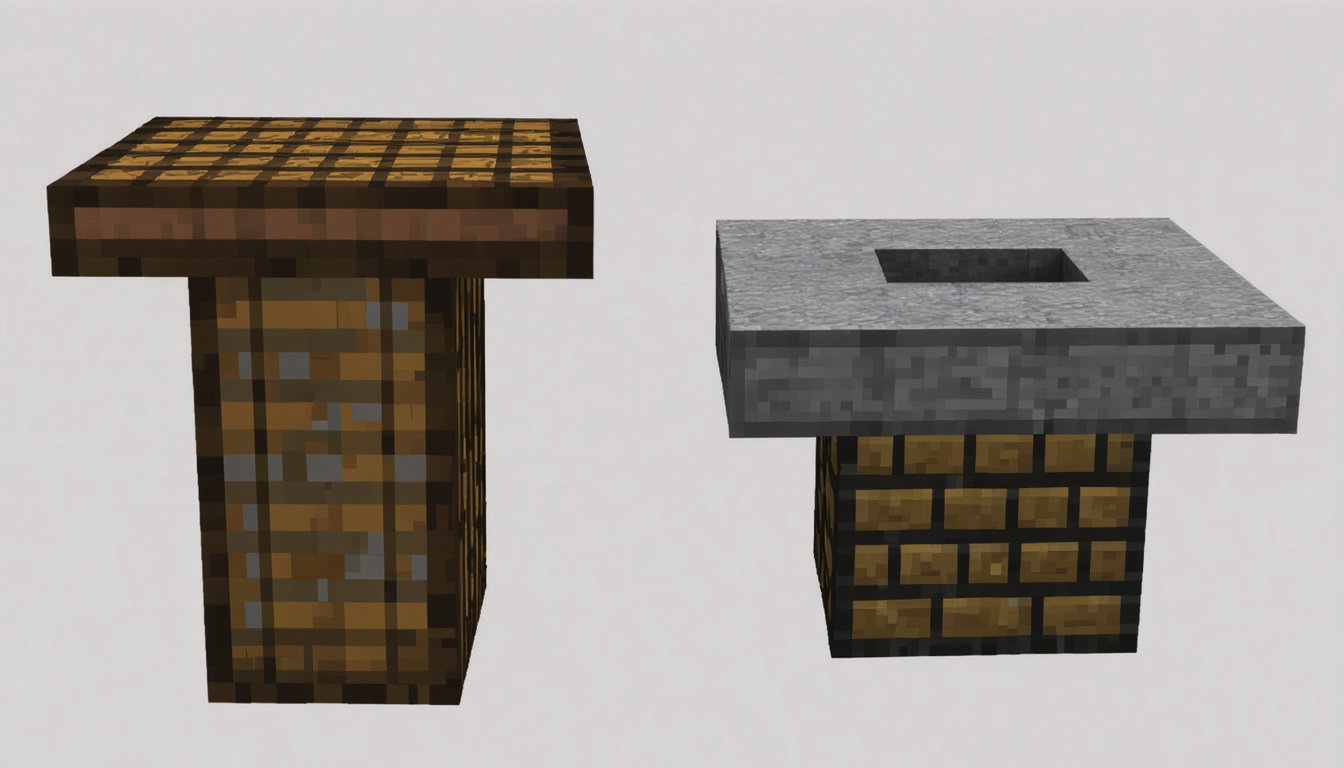
At the heart of the available methods to remove an enchantment, the grindstone occupies a central place. In Minecraft, it is the only truly effective and accessible vanilla method to remove enchantments from an item. However, its functioning must be well understood to use it wisely.
The grindstone does not “disenchant” in the sense of recovering the enchantment; it erases all non-cursed enchantments present on the item, without exception, in exchange for partial experience compensation. This action is therefore irreversible: the item becomes blank again, without enchantment, and the original enchantments are permanently removed.
To use the grindstone, simply right-click on it, then place the enchanted item in one of the two input slots. The grindstone will display the disenchanted version of the item in output. Its cost in experience points is indicated in green and depends on the power and number of enchantments removed. The use requires no other material, making it practical and fast.
In terms of in-game acquisition, grindstones naturally generate in villages, often near the armorer’s houses. This allows players to easily access them without initial cost. Otherwise, they can be crafted via a simple recipe:
| Required material | Quantity | Method of acquisition |
|---|---|---|
| Sticks | 2 | Crafted from wooden planks |
| Wooden planks | 2 | Any type of wood |
| Stone slabs | 2 | Smelting cobblestone into stone, then crafting slabs |
Note that the slabs must be “cooked” stone slabs, not plain cobblestone slabs for the recipe to work.
Despite its usefulness, the grindstone has several important limitations:
- It removes all enchantments at once: impossible to target a specific enchantment to remove.
- Curses cannot be removed: they remain attached to the items for their entire lifetime.
- The removal is immediate and irreversible, with no possibility of recovering lost enchantments.
For serious players, the grindstone is therefore an indispensable tool but must be handled with care. It allows correcting enchantment errors or recycling items no longer useful in an enchanted state, while recovering part of the invested experience.
Practical example of using the grindstone
Imagine you have a sword enchanted with Fire Aspect and Sharpness, but you prefer to start over with a plain sword to enchant differently. Placing this sword in the grindstone will immediately remove both enchantments, returning some experience to you. Note that the experience cost remains moderate on low-level items but grows significantly on very powerful items.
The limits of the anvil faced with disenchantment in Minecraft
The anvil is another major tool concerning the management of enchantments in Minecraft. Unlike the grindstone, it does not remove enchantments but allows their combination and the repair of enchanted items without acceptance of loss.
With the anvil, you can merge two identical items or combine an item and an enchanted book to accumulate their enchantments. This process is essential to optimize your gear by gradually adding better bonuses. It is also possible to repair equipment using the appropriate materials (ingots, diamonds, etc.) while preserving existing enchantments.
The fundamental point is that the anvil does not allow removal of an enchantment, which pushes back the question of pure and simple disenchantment. Furthermore, each use increases the experience level cost, and beyond 39 levels, operations become impossible on that same item due to the “Too Expensive” limit.
Thus, there is a need to carefully plan your combinations, favoring the grouping of enchanted books before applying them to the final item. This method minimizes the overall cost and avoids premature level blocking.
Finally, the anvil has a workaround use allowing to neutralize certain curses like “Curse of Vanishing” via a simple crafting combining two identical items, although this technique is unintuitive and rarely included in classic guides.
Comparative table: grindstone vs anvil in enchantment management
| Criteria | Grindstone | Anvil |
|---|---|---|
| Enchantment removal | Yes, all at once, no choice | No, only merging or repairing |
| Experience cost | Partial, varies according to enchantments removed | High, increases with each use |
| Enchantment recovery | No, permanently destroyed | No, but merges enchantments |
| Curse removal | Impossible | Possible via combined craft |
Strategies to optimize enchantment use without loss in Minecraft
Given the impossibility to recover a removed enchantment, the winning strategy in Minecraft is to maximize the use of valuable enchantments. This includes several best practices:
- Keeping enchanted items despite their apparent low quality: For example, a gold pickaxe considered fragile can prove very useful if it has the Mending and Unbreaking III enchantments, as it repairs itself automatically by gathering experience.
- Regular repair via anvil: Rather than risking loss by dismantling equipment, prefer repairing with appropriate materials, which preserves all enchantments intact.
- Storing enchantments as enchanted books: Enchanting books via the enchantment table allows you to keep rare enchantments and choose later on which tool to apply them.
These methods combine their positive effects by making your arsenal stronger and adaptable to varied game needs. Regarding fishing, using a fishing rod enchanted with Luck of the Sea III makes obtaining enchanted books repeatedly much easier, creating a steady flow of magical resources.
Librarian villagers play an essential role here by providing enchanted books in exchange for emeralds. Their profession can be reset until the exact combination of enchantments you are looking for appears. Managing these trades requires some patience, but it’s a reliable way to obtain rare enchantments like Mending or Silk Touch.
How to create and effectively use an enchantment table to obtain enchanted books
The enchantment table is the foundation of any process to improve your items in Minecraft. To fully benefit from the most powerful enchantments, it is essential to properly configure the environment around your table to reach level 30, the maximum allowed for the most advanced enchantments.
This requires surrounding the enchantment table with 15 bookshelves, positioned at a precise distance (an air block between the bookshelves and the table). This detail is often overlooked, and failing to respect this configuration leads to a frustrating cap on the accessible enchantment level.
Enchanting books offers the major benefit of preserving enchantments, which is impossible with directly enchanted items. Once enchanted, these books can later be applied by combining on the item of your choice using the anvil. This method offers strategic flexibility, allowing you to adapt your equipment according to current game needs.
Chests in generated structures often contain specific enchanted books. These hidden treasures complement the standard offer and enrich the diversity of available enchantments. They constitute a valuable resource for players seeking advanced optimization.
The best tips to obtain rare enchanted books
- Use fishing with a Luck of the Sea III enchanted fishing rod to maximize chances of obtaining rare enchantments.
- Locate and trade with librarian villagers, resetting their profession to target specific enchantments.
- Explore ruins, bastions, and End cities to find chests containing rare enchanted books.
- Create automatic experience farms to speed up emerald collection and finance trades.
Common mistakes to avoid when disenchanting in Minecraft
Minecraft is full of subtleties, and disenchantment is no exception with its share of common mistakes
- Confusing the grindstone with the anvil: Many beginner players try to remove an enchantment with an anvil, which is impossible. The correct tool for this action is the grindstone.
- Using the grindstone without paying attention to curses: Curses like Curse of Binding remain on the item even after disenchantment, which can lead to unpleasant surprises.
- Losing valuable enchantments due to lack of planning: Accidentally removing a rare enchantment can be very frustrating. Take the time to evaluate whether you need to disenchant or rather repair/merge.
- Misplacing bookshelves around the enchantment table: This limits access to high-level enchantments and reduces the effectiveness of your enchanting sessions.
By avoiding these pitfalls, you will gain efficiency and mastery, allowing you to combine gaming pleasure and frustration-free progression.
The future prospects of disenchantment in Minecraft: innovations and expectations
Since the last major updates, the Minecraft community remains very attentive to possible evolutions in the enchantment management system. In 2026, some mods and custom servers offer possibilities for partial or complete transfer of enchantments, but these features remain largely absent from vanilla gameplay.
Debates about integrating a system for recovering or transferring enchantments are recurring within the community. Although Mojang remains cautious on this point, maintaining a balance between difficulty and progression, player feedback and technical innovations hint at possible evolutions in the coming years.
Furthermore, other video games exploiting similar mechanics take inspiration from Minecraft while offering more flexibility in handling enchantments and magical items. Studying these systems could influence future iterations of Minecraft to provide better comfort while respecting the game’s philosophy.
Meanwhile, mastering the grindstone and anvil as well as strategies for obtaining and managing enchantments remains the key to success for any player aspiring to a smooth and rewarding experience in Minecraft.