
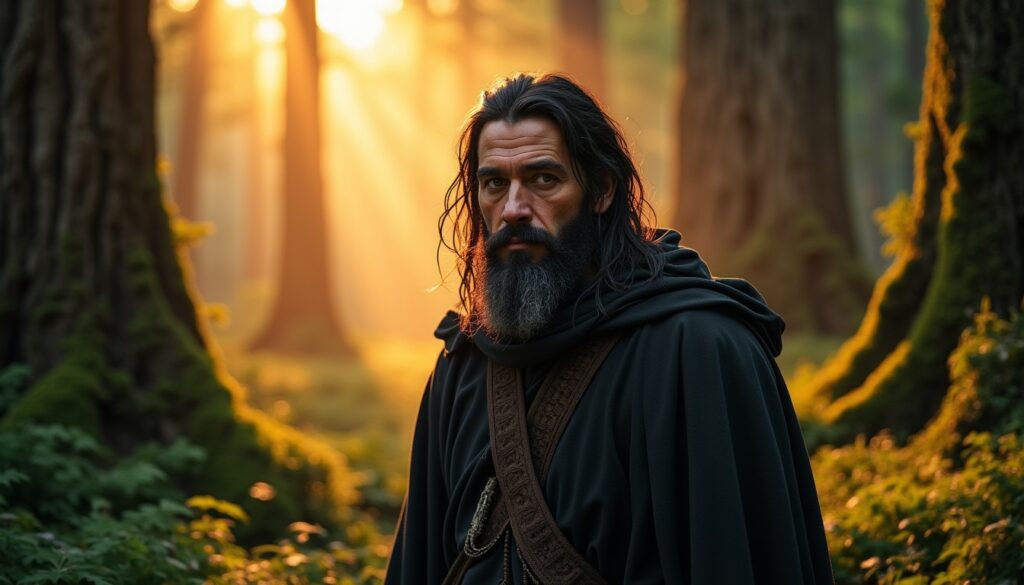
At the dawn of 2026, Tolkien’s dense and fascinating universe is enriched with the series The Rings of Power, which offers a fresh perspective on Midd-earth before the legendary events of The Lord of the Rings. At the heart of this epic fresco, Adar stands out as a key character, bearer of a deep mystery and a complex origin. Born from the screenwriters’ imagination, this father of the Orcs embodies the tension between light and darkness, noble and monstrous.
In this new fantasy series, the creation of the Orcs, long shrouded in the shadows of Tolkien’s tales, finds a bold reinterpretation. Adar, an elf corrupted by Morgoth, appears not only as their leader but also as a protector, challenging the usual codes of malevolence in Tolkien’s mythology. This ambiguous figure reinvents the dynamic between orcs and elves, exploring moral nuances rarely addressed in previous works.
The mystery surrounding Adar goes beyond his simple nature as an antagonist. He is both a source of terror and empathy, unveiling in the process unknown parts of the ancient lands and the genesis of Mordor. His quest to forge a home for his orc children, against Sauron’s tyranny, highlights a poignant paradox: that of a villain capable of true love. Here is a pivotal figure inviting a reconsideration of the complexity of dark forces and the richness of Tolkien’s mythology in a respectful yet innovative adaptation.
The secret origins of Adar and the creation of the Orcs in Middle-earth
The series The Rings of Power introduces Adar as a major enigma, a character who does not appear in Tolkien’s original texts but whose role proves crucial to understanding the birth of the Orcs. Traditionally, Orcs are described as creatures born from the corruption of Elves by Morgoth, the first Dark Lord. Adar, according to the series, would be an ancient Avari elf, captured and perverted by Morgoth, transformed into what could be called a proto-Orc, at the crossroads between elvish light and malevolent darkness.
This origin is fascinating because it explores an important shadow zone in Tolkien’s timeline. The Avari Elves are known for having refused the call to Valinor, preferring to remain in Middle-earth. Among them, the Moriondor are precisely those who, through Morgoth’s violence, underwent a drastic transformation. Thus, Adar embodies this primal tragedy that gave rise to the orcs: a brutal mixture of corruption and abandonment.
The depiction of Adar as a rebellious ancient elf translates a bold choice by the creators. He is no longer a mere monster, but a survivor of a torn history, capable of maintaining a form of nobility even at the heart of his darkness. This complexity enriches the narrative by painting an ambivalent figure close to other anti-hero portraits in modern fiction.
The series also highlights the physical violence of this transformation, visible through Adar’s scarred face, requiring seven hours of makeup to capture his scars and hybrid nature. This immersive approach adds tangible depth to the character, making Adar a living embodiment of the consequences of the war between the first dark lords and the forces of light.
To illustrate this point, here is a summary table of the key stages of Adar’s transformation:
| Phase | Description | Consequences |
|---|---|---|
| Original Avari Elf | Adar is part of the Elves who stayed in Middle-earth | Elvish identity initially intact |
| Capture by Morgoth | Kidnapped by the first Dark Lord | Start of physical and mental deformation |
| Progressive corruption | Mutation into proto-Orc | Disfigured appearance; internal conflict |
| Adoption of the role of father of the Orcs | Leader of creatures born from corruption | Paternal relationship with the Orcs |
This contemporary reinterpretation fits perfectly with today’s spirit of stories that seek to overcome manichean dichotomies to embrace characters with deep gray areas.
Adar’s paternal role: a fresh look at the Orcs and their humanization
In the universe usually perceived as rigid of the Lord of the Rings, the figure of Adar profoundly renews the representation of the Orcs. Far from being mere servile and brutal creatures, Adar brings them a human and affectionate dimension, which can be described as unprecedented.
This new father of the Orcs is shown in the series as a protector of his “children” orcs, whom he tenderly calls “Uruk”. This appellation is not trivial since this term in Black Speech designates these creatures, but with Adar, it becomes a sign of affection and responsibility. He refuses the inhumane treatment that Sauron inflicts on them, where they are only pawns to be sacrificed in his quest for power.
Adar embodies an attempt to build a home, a safe place where Orcs could exist away from the light, which they badly tolerate. This ambition is both pragmatic and motherly, giving a new perspective on what it means to be “evil” in Tolkien’s mythology. The character is thus depicted as morally ambiguous, shaped by his scars but still capable of empathy.
This positioning raises fundamental questions: what is it in the very essence of a creature that determines its potential for good or evil? The series urges a reevaluation of these notions through the prism of Adar and his alternative vision of the Orcs’ fate.
Another striking aspect is his break with Sauron. Adar claims to have temporarily killed the Dark Lord, arguing that the latter is a cruel and destructive false god. This opposition intrigues because it shows the multiplicity of dark forces in Middle-earth, each faction deriving its legitimacy from its own system of values, even in evil.
- Empathy towards his “children” Orcs: despite their feared nature, Adar gives them a sense of community and protection.
- Building a home away from the sun: he wants to create an environment where Orcs no longer suffer.
- Opposition to cruelty: harsh criticism of Sauron’s ruthless methods.
- Enlightened leadership: at the head of a disciplined army, he is a formidable strategist.
This portrait of Adar breaks with clichés and invites a more subtle reading of antagonists in Tolkien’s work. It reminds us that villains are not always programmed for disinterested destruction but can carry causes, even misguided ones.
The physical and psychological transformation of Adar: between elvish light and orc shadow
Adar is not limited to a narrative function: his appearance is a powerful visual dialogue between the themes of creation and destruction. The character bears on him the marks of a terrible transformation, oscillating between his elvish heritage and the threat he has become.
The visual design in the series is impressive. Every scar, every deformation on Adar’s face tells a story of suffering and struggle against his own nature. The influx of makeup, transforming the actor, expresses this duality: a being torn between apparent nobility and relentless corruption.
Psychologically, Adar traverses a field of contradictions. His rejection of Sauron is partly motivated by a desire to protect his followers, unlike a mere thirst for power. This complex psychology enriches the plot, offering an antagonist capable of nuanced emotions, a significant break with traditional manichean groups.
During season 2, a notable event temporarily changes his condition: the capture of Nenya, Galadriel’s elvish ring, allows him to reconnect with his original elvish nature, partially healing his corruption. This moment is a strong point that raises the question of the potential for redemption even for the most damaged.
Here is a list of the key visual and psychological elements of Adar’s transformation:
- Deeply scarred and marked face
- Use of long-lasting makeup (up to 7 hours)
- Behavior both threatening and protective
- Internal conflict between the elf he was and the orc he has become
- Moments of clarity and healing thanks to the elvish rings
This duality allowed the two actors who played Adar, Joseph Mawle for season 1 and Sam Hazeldine for season 2, to portray a whole range of emotions from anger to anguish, bringing to life a character of great depth.
The actors portraying Adar and the importance of casting in the fantasy series
The role of Adar requires a strong and nuanced stage presence, capable of navigating between threat and vulnerability. For season 1, it was Joseph Mawle who embodied this emblematic character. Known for his performance in Game of Thrones, Mawle gave Adar a controlled strength, combining the pain of a tragic past with the determination of a leader.
The switch to Sam Hazeldine for season 2 caused questions among fans. This change is mainly related to scheduling constraints, but Hazeldine took on the major technical challenge posed by the makeup, which now lasts seven hours every day of shooting. This testifies to the demand for faithful representation of Adar on screen.
The casting was also crucial to convey the wounded nobility of the character, who was not meant to fall into a caricatural villain archetype. Each actor had to explore Adar’s duality while maintaining emotional credibility.
In a series where Tolkien’s mythology resonates strongly, the choice of actors capable of humanizing even the darkest figures is essential. Adar, as a pivotal figure, embodies this ambition to offer the audience a deeply rich and emotionally charged experience.
Adar’s strategic role in the transformation of the Southlands into Mordor
The series details how Adar, through his ambition, orchestrated the geopolitical transformation of the Southlands. His goal: to establish a shadow kingdom where Orcs could thrive outside Sauron’s destructive grip. This maneuver culminates with a cataclysmic event – the eruption of Mount Doom – which will give birth to Mordor as known in later legends.
This reinterpretation is particularly inventive as it assigns Adar the role of a main actor in a major natural phenomenon, effectively a forger of the mythical landscape. The birth of Mordor thus becomes not simply a geological fact but also the result of internal struggles among the forces of evil.
Adar relies on a disciplined army of Orcs, guided by his vision of the future. His enlightened leadership, combined with rigorous military strategy, allows him to capture elves like Arondir and to arrange tunnels and underground fortifications. He also uses symbolic objects, such as cult swords, to assert his power.
Here is a table illustrating the main phases of actions taken by Adar in the Southlands:
| Action | Description | Effect on Middle-earth |
|---|---|---|
| Capture of elves (e.g. Arondir) | Weakening of local resistances | Consolidation of Orc domination |
| Destruction of dams | Flooding of tunnels leading to Mount Doom | Creation of a hostile volcanic terrain |
| Use of artifacts | Symbolic and material conquest | Strengthening of Adar’s authority |
| Triggering the volcanic eruption | Initiation of Mordor’s birth | Establishment of a bastion of evil |
Adar’s ability to alter the geography and power relations in Middle-earth highlights his strategic importance, far exceeding that of a mere fantasy series antagonist. He appears as an architect of destiny, whose impact will resonate through ages to come.
Adar’s influence on the renewed Tolkien mythology for the fantasy series
With Adar, the series The Rings of Power aims to reinterpret Tolkien’s mythology with a fresh perspective, going beyond traditional tales to explore the shadows and complexities often left aside. His very existence sparks a debate around canon and narrative liberties.
While some purists regret that this character does not appear in the original texts, it is obvious that this creation brings a welcome narrative richness. It renews the stakes by humanizing the dark forces and giving a face to the genesis of the Orcs, until now very vague.
It also invites reflection on the impact of modern storytelling on ancient myths, and how adaptations can offer viewers an enriched and contemporary experience. For example, ecological awareness and the idea of protecting a “rejected people” like the Orcs resonate with current themes of social justice.
In 2026, where pop culture evolves rapidly, Adar embodies an archetype of antagonist both frightening and understandable, contributing to better diversity in fantasy narratives. His complexity invites revisiting great classics with critical open-mindedness and renewed empathy.
Psychological and moral exploration of Adar facing Middle-earth’s darkness
Adar magnificently illustrates the moral tension between fate and free will, between shadow and light that traverses Middle-earth. His character is torn between his elvish past, a source of nobility and beauty, and his current condition, prisoner of a marked body and an imposed role.
This internal duality fuels his personal struggle that goes beyond the simple quest for power. He challenges Sauron’s brutal leadership and initiates, for the first time in this mythology, a debate on the possibility of evil serving a form of love and protection.
Adar’s ambivalence encourages the viewer to look beyond appearances and to consider that even in the deepest darkness, human motives can exist. This enriches the narrative experience by transcending heroes and villains, while offering a subtle critique of fate in great epic stories.
This psychological aspect is reinforced by his moments of hesitation, his dialogues filled with melancholy and a soft, almost paternal anger. The character thus becomes a complex mirror of our own human contradictions, making his journey all the more poignant and captivating.
Adar and the legacy of the new Lord of the Rings adaptations in 2026
In 2026, while the Lord of the Rings saga continues to influence the collective imagination, Adar’s appearance in The Rings of Power marks an important milestone in the evolution of Tolkien adaptations. He exemplifies how contemporary fantasy can revisit and enrich existing mythologies.
The series also illustrates how creators adapt to the expectations of a modern audience, more demanding of psychological depth and moral complexity. Adar, this “noble villain,” is thus a relevant response to the monochrome characters of the past, in tune with current narrative trends.
His role could have a lasting influence on how future works explore the nature of dark forces in Middle-earth. In an industry dominated by the quest for authenticity and narrative diversity, Adar emerges as an emblematic figure of a fantasy in full transformation, able to regenerate Tolkien’s legacy while addressing a new audience.