
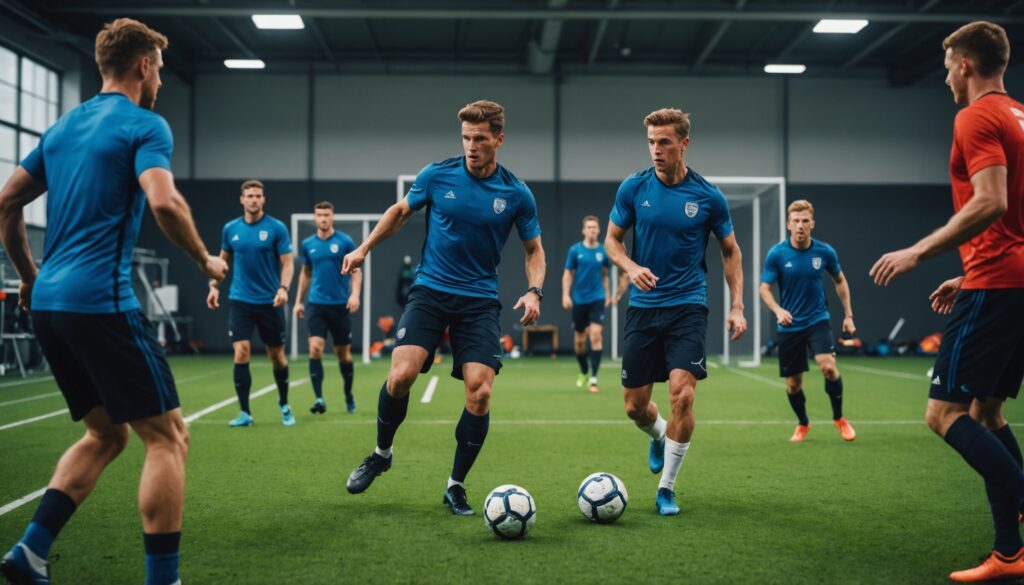
In the world of football, where every millisecond can change the course of a match, stimulating players’ reflexes becomes an absolute priority. In 2026, traditional training methods have given way to more innovative approaches, integrating interactive gaming to improve reactivity, agility, and hand-eye coordination of football players. These technologies are not only used to increase fun during sessions, but have become catalysts for sports performance, combining the pleasure of educational video games with suitable physical exercises. This evolution is revolutionizing not only the way players train but also promotes essential mental development in the face of the constant pressure of professional matches.
Modern coaches draw heavily on video game mechanics to structure exercises that push players to think, anticipate, and react quickly and accurately. It is no longer just about physical movements but a true cognitive training where the speed of decision-making matters as much as technique. For example, interactive platforms like Melbet Plinko offer dynamic simulations where the player must manage stress and risks while maintaining maximum concentration, which prepares footballers to handle the unpredictable on the field. This approach is all the more relevant in a sport where anticipation and coordination are decisive.
The shift from repetitive routines to real-time training situations promotes rapid and lasting assimilation of the skills required to stand out in competitions. In this new infrastructure, each session becomes a challenging test that encourages healthy competition, not only against other players but also against oneself. The experience gained on interactive mats, light walls, or equipment equipped with sensors improves cognitive speed in contexts close to reality. This method builds better self-awareness, physical and artistic abilities, as well as optimal pressure management.
- 1 How interactive gaming revolutionizes football training and stimulates fast reflexes
- 2 Football training: stimulating reactivity and decision-making under pressure
- 3 The role of agility and hand-eye coordination in developing football reflexes
- 4 Concrete transformations brought by interactive gaming in football training methods
- 5 Examples of reflex stimulation exercises for footballers via interactive gaming
- 6 The role of emotional management and concentration in developing football reflexes
- 7 Future perspectives and innovations in reflex stimulation for footballers
How interactive gaming revolutionizes football training and stimulates fast reflexes
The revolution in football training is rooted in the rise of immersive and interactive technologies that are now integral parts of modern training centers. These tools enable targeted football training, leveraging mechanisms that strengthen players’ reflex speed.
Traditionally, reflex training involved repetitive exercises focusing exclusively on execution speed. This lack of variety could decrease motivation and limit progress. Today, with the arrival of systems based on interactive gaming, scenarios are varied and unpredictable, pushing players to constantly adapt. This recreates the dynamics of a high-intensity match, with destabilizing situations requiring instant responses.
A central mechanism is the integration of random triggers. These triggers, whether visual or auditory, introduce an element of surprise, mimic the unpredictables of matches, and simulate the need for quick decision-making. For example, lights placed on an interactive mat light up randomly, forcing the player to react immediately with a precise movement. This repetitive but appreciated work strengthens execution speed, concentration, and the ability to quickly change direction.
The points and rewards established in these exercises provide immediate feedback, encouraging constant engagement and repetition of efforts. This results in stimulating competition between players or a desire to beat one’s own record, increasing intrinsic motivation. Thus, a touch of play and stakes energizes a training session by turning a tedious task into a competitive and rewarding experience.
This playful approach also translates into durable improvements of physical skills specific to football. Hand-eye coordination is notably enhanced thanks to the rapid manipulation of the ball in interactive exercises and the simultaneous management of visual and auditory signals, which amplifies gesture precision. Mentally, this preparation increases the player’s ability to remain alert and clear-headed even under high pressure, a valuable asset in the context of a tight match.
Football training: stimulating reactivity and decision-making under pressure
In a sport where differences are often decided by a fraction of a second, reactivity is a key factor. Football is no longer measured just by physical capacity but also by the speed of information processing and rapid execution of decisions. From this perspective, integrating interactive games into football training offers considerable benefits.
Reactivity is not limited to mere speed of movement; it also encompasses an essential cognitive dimension: knowing how to analyze, anticipate, and act precisely. It is no longer just about running fast or changing direction but about making the right decision in real time. For instance, during interactive exercises, scenarios with colored light signals require the player to respond differently according to the stimulus, thus working their ability to process several variables simultaneously.
Professional club coaches report that these trainings make players more confident. For example, a midfielder can now detect an opening in the defense more quickly and initiate a decisive pass before the opponent reacts. Similarly, goalkeepers develop an improved ability to anticipate shots and adjust their reactions based on unpredictable ball trajectories.
Moreover, the educational video game integrated into training programs creates a safe environment where players can test their limits without fear of physical error. These games allow infinite repetition of tactical combinations in a playful form while strengthening quick reflexes. By surpassing the routine of classic exercises, the player maintains heightened concentration, which promotes muscle memory and spontaneous initiative-taking in matches.
The concept stems from a keen understanding that pressure is omnipresent in competition. Interactive games act as simulators where pressure is reproduced along with real emotions and demands. Consequently, they prepare both body and mind for the intensity of the field, making the implementation of strategies more natural.
The role of agility and hand-eye coordination in developing football reflexes
Agility and hand-eye coordination are two essential pillars for footballers to sharpen their quick reflexes. In a game where the ball’s trajectory often changes unpredictably, the ability to adjust the body in real time is fundamental.
Interactive exercises have helped create new protocols that integrate these elements in synchronized sequences. For example, platforms where LED sensors indicate where to position the foot or how to orient the body encourage agility through precise gestures. This precision is trained in real time, with immediate feedback on the quality of the response, causing progressive and measurable improvement.
Significant improvement is also observed in hand-eye coordination. Interactive platforms and games ask the player to associate a physical action (ball control, pass) with a visual or auditory stimulus. This simultaneous work favors rapid nerve transmission between the brain and muscles, optimizing movement fluidity.
A French club recently integrated this form of training and reports that its players’ reaction speed increased by nearly 25% in a few months, with better balance management during high-speed actions. These results reflect a clear transfer to the real game where technical mastery is now combined with increased movement intelligence.
This training method also intensifies spatial understanding. In football where space is constantly shrinking, knowing how to position oneself instinctively and coordinate movements according to the immediate environment has become indispensable to create decisive actions.
Concrete transformations brought by interactive gaming in football training methods
The transformation of training methods thanks to interactive gaming is illustrated by concrete and measurable innovations. These changes affect not only the quality of physical execution but also the depth of players’ cognitive and emotional development.
Modern equipment now includes:
- Motion sensors allowing precise measurement of muscular and postural reactions during exercises.
- LED systems that trigger random signals to force quick decision-making and improve visual reactivity.
- Real-time analysis software offering personalized monitoring, enabling coaches to adjust the difficulty according to each player’s profile.
This ultra-modern setup is, for example, used by FOOTPERFS TECHNOLOGIES by CHERRY OPS, whose interactive equipment offers a stimulating environment where each session is adapted based on previous performances. The player receives concrete feedback, notably on cognitive speed, ball control, and the ability to manage pressure.
These innovations help prevent premature player exhaustion by optimizing workload. Precise data tracking helps detect signs of fatigue before they impact performance. This prolongs the optimal fitness duration and reduces the risk of injury.
A summary table below illustrates the main benefits brought by interactive tools:
| Aspect | Before (classic methods) | With interactive gaming |
|---|---|---|
| Motivation | Routine, uninspiring exercises | Playful, competitive, and stimulating environment |
| Reflex precision | Repetitive, fixed reactions | Responses to random and varied stimuli |
| Personalization | Global and uniform approach | Real-time adaptation based on profile |
| Fatigue monitoring | Often ignored or poorly anticipated | Continuous monitoring with preventive alerts |
| Mental impact | Less integrated | Cognitive training and emotional management |
Through targeted improvement of speed and hand-eye coordination, these new training modes revolutionize the physical and mental preparation of professional and amateur footballers.
Examples of reflex stimulation exercises for footballers via interactive gaming
There are many exercises designed to fully exploit the potential of interactive gaming to improve reflexes and quick decision-making. Here is a practical illustration of commonly used methods:
- The reactive training mat: Light sensors turn on in specific zones of the mat, and the player must quickly touch the correct zone with their foot. The difficulty increases based on speed and accuracy.
- The interactive passing wall: The player receives a ball and must pass towards luminous targets that light up randomly on a wall, improving precision, anticipation, and hand-eye coordination.
- The cognitive speed challenge: Fast-paced visual and auditory signals require the player to perform a series of specific actions (pass, dribble, shoot) in a very short time.
- The risk management game: Inspired by video games like Melbet Plinko, players choose moves or strategies within a limited time with immediate consequences, strengthening the ability to decide quickly under pressure.
These exercises combine the playful aspect of educational video games with precise goals to improve reflexes, maximizing participation and promoting rapid progress.
The role of emotional management and concentration in developing football reflexes
Beyond speed and agility, football is a sport where self-control plays a crucial role. Stimulating reflexes necessarily involves the ability to manage stress, maintain concentration, and control emotions.
Interactive games often include mechanisms rewarding speed without hesitation but also the ability to remain calm in stressful contexts. For example, losing points for hesitation encourages better pressure management during matches. This feature is essential: the difference between a good-level player and an elite player often lies in this emotional control.
Moreover, the regular repetition of exercises requiring high concentration helps players adopt a mental state close to mindfulness. This practice allows them to remain in the present moment, avoid distractions, and improve decision accuracy.
Furthermore, real-time feedback provided by these interactive tools gives the player the possibility to self-analyze their performance and adapt their behavior, a key aspect for autonomous and sustainable development. It is a school of resilience where body and mind are simultaneously prepared to face the field’s constraints in the best possible conditions.
Future perspectives and innovations in reflex stimulation for footballers
With the rapid advancement of technologies, football training will continue to evolve, particularly in reflex stimulation via interactive gaming. Innovations planned for 2026 announce a future where immersive experience and personalization will reach a new level.
Augmented reality and virtual reality are already established in some training centers. They will soon allow footballers to experience even more realistic game situations, where pressure, speed, and unpredictability can be simulated with unprecedented fidelity. These tools claim to strengthen reactivity and decision-making in conditions almost identical to matches.
In addition to these technologies, artificial intelligence algorithms capable of analyzing every movement in real time to propose personalized corrections and exercises adapted to individual profiles are emerging. This combination will elevate training to a sophisticated scientific level, without ever losing the pleasure of educational video gaming that motivates the player.
Another area of progress involves integrating biological parameters such as heart rate, muscle fatigue, or stress level. These data, coupled with performance on interactive platforms, will allow even finer session customization, respecting the body and maximizing performance gains.
These innovations promise to change the way talents are detected and trained, offering complete immersion and precise monitoring from discovering the basics of football to the highest international level.