
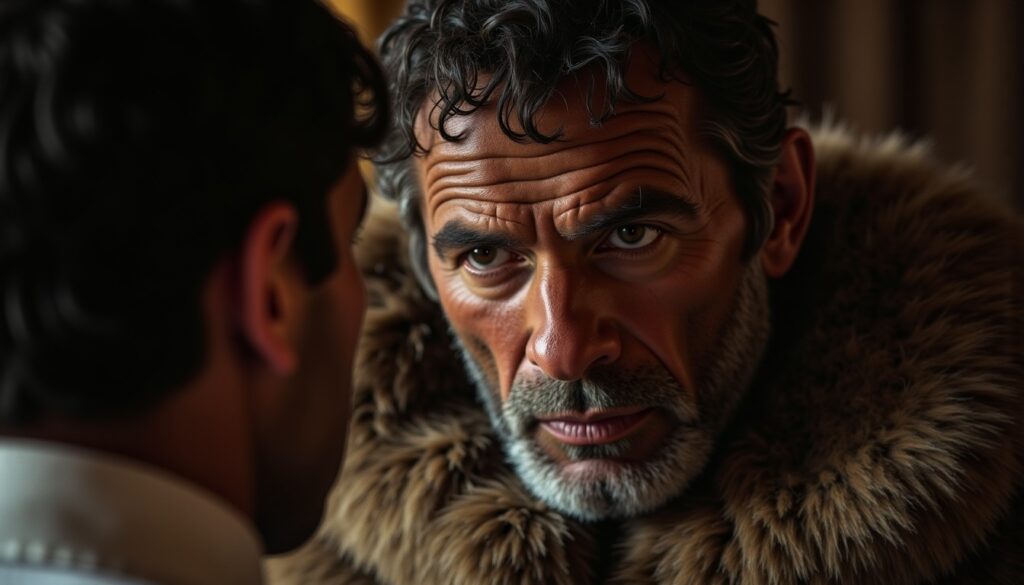
Released in 1963, The Leopard by Luchino Visconti establishes itself as a monument of Italian cinema, celebrated for its sumptuous staging and poignant perspective on the decline of an era. Palme d’Or at the Cannes Film Festival the same year, this classic film transcends the simple framework of a historical drama to immerse the viewer in a deep meditation on the passage of time, social transformations, and the weight of history. The final sequence, in particular, remains one of the most striking in the seventh art, skillfully combining intense emotions with powerful symbolism.
This scene concludes a narrative that follows Prince Salina, a Sicilian aristocratic figure facing the inexorable rise of the bourgeoisie during the Italian Risorgimento. Luchino Visconti exploits every moment to expose not only characters but also an era, a breath that is fading away. The way the film’s tragic ending is orchestrated attests to an extreme attention to detail, authentic sets, and the subtle acting of the performers. Let us explore how this last sequence embodies a whole chapter of Italian history and why it continues to captivate critics and audiences alike, even in 2026.
The Leopard: Symbolism of Aristocratic Decline Amidst the Rise of the Bourgeoisie
At the heart of The Leopard lies a historical observation that is both brutal and beautifully rendered: the twilight of an immutable aristocracy facing the ascent of a conquering bourgeoisie. Prince Salina, embodying Sicilian nobility, watches almost helplessly as a world he once dominated for decades dissolves. This silent struggle plays out less in loud confrontations than in looks, silences, and deep melancholy.
Luchino Visconti depicts a world frozen in its traditions and codes while Sicilian society undergoes profound transformation. The Prince clearly realizes that his end is inevitable. This lucidity gives the character a tragic and restrained dimension, one who acknowledges that the new social class, especially embodied by Don Calogero Sedara, is destined to govern. The film thus illustrates the famous formula: “We were the leopards, the lions; those who replace us will be the jackals, the hyenas.” It is a farewell to a proud but resigned aristocracy, where time seems suspended yet inexorable.
The contrast between these two worlds is omnipresent: the Prince’s outdated elegance, polite deference toward the nouveaux riches, politics perceived as a farce betraying true popular interests. Visconti’s commentary goes beyond a simple historical chronicle: he questions the very essence of power and its permanence disguised under various forms. This observation remains relevant until 2026, when considering recent political changes, where new elites take precedence over established institutions, yet power dynamics and influence games retain striking similarities.
The historical drama thus unfolds primarily within the awareness of disappearance, in the painful and dignified acceptance of a time that will not return. The character Tancredi, the Prince’s nephew, symbolizes compromise and adaptation, representing a youth that knows how to navigate between noble past and bourgeois future. This impassive witness perhaps embodies the very key to the social change portrayed by the film. He knows the past is over, and he chooses to integrate into the rising wave rather than oppose it.
A Meticulous Filming of the Final Scene, a Peak of Italian Cinema in 1963
The memorable ending of the film concludes with an extended ballroom scene, unique in its kind. Lasting around 45 minutes, it was shot over 48 days with remarkable discipline, involving 300 extras in the splendid Palazzo Gangi in Palermo. This deliberate choice of an authentic location rather than an artificial set gives the sequence a period atmosphere of rare intensity.
Luchino Visconti, a recognized perfectionist, used more than 393 costumes, all meticulously designed to accurately reflect the splendor and social contrasts of 19th-century Sicily. The lighting is candlelit, not for modernity but for artistic intent, to evoke the softness and intimacy of aristocratic evenings of that era. This technical requirement transports the viewer to the heart of a forgotten time, where every reflection on silk dresses, every shadow cast on the palace walls tells a story.
This lengthy ballroom scene is a visual masterpiece that also testifies to a logistical feat. The table below summarizes the key aspects of the production:
| Key Element | Detail |
|---|---|
| Scene Duration | 45 to 50 minutes |
| Filming Period | 48 days, between 7 p.m. and dawn |
| Number of Extras | 300 |
| Number of Costumes | 393 unique costumes |
| Location | Palazzo Gangi, Palermo (Sicily) |
This hard work was long hailed as one of the peaks of Italian film production, offering a spectacle that masterfully combines decadent luxury and the muted melancholy of a social class in decline.
Detailed Analysis: The Symbolism of the Waltz Between Prince Salina and Angelica
The dance between Prince Salina and Angelica Sedara, wife of his nephew Tancredi, constitutes the emotional core of the final scene. Inviting the Prince to waltz, Angelica expresses her gratitude for his role in their union, which symbolizes the alliance between the declining aristocracy and the rising bourgeoisie. This waltz embodies much more than a mere festive moment: it restores youth and fleeting passion, a moment suspended in time.
For the Prince, this moment of grace transforms into an almost metaphysical experience. He regains, for a few steps, the vigor and beauty of a bygone age before plunging back into the deep melancholy of the impending end. Tancredi’s gaze, observing this dance, betrays a complex mixture of admiration, jealousy, and sadness. This silent triad reveals the tension between generations, the inevitable passing of the torch, and the gradual erasure of an ancestral culture.
This scene can be compared to other memorable moments in cinema where dance is more than a spectacle: it is a metaphor for life itself. Visconti’s subtlety lies in revealing through this waltz the contradictions of a world in full mutation. The flamboyant youth embodied by Angelica also carries new ambition, while the Prince dances with the awareness of his own disappearance.
This passage remains a source of inspiration and analysis for cinephiles worldwide today, continually renewing reflection on time, memory, and change.
The Waltz as a Metaphor for Time and the Passage of Generations
The waltz, through its rhythm and choreography, symbolizes here the fluidity of time and the inevitable rotation of generations. Angelica, young and ambitious, represents the future asserting itself while the Prince, whose every movement reflects fatigue and dignity, is the remnant of a glorious past. Their dance is a fragile balance between attachment and renunciation.
This social ballet is highlighted by the music, a melody accompanying their evolution throughout the scene, amplifying the emotion and giving the ending an almost poetic breath.
The Silent Departure of Prince Salina: A Poignant Acceptance of the End of an Era
After the effervescence and brilliance of the ball, the Prince chooses to slip away quietly, far from the bustle and the gazes. This discreet exit embodies a form of ancient wisdom: understanding that some things must end, peacefully, with dignity.
His last look toward the sky, accompanied by his inner prayer “Star, faithful star, when will you grant me a less fleeting rendezvous…”, offers more than a psychological end for the character; it is a universal symbol resonating with the very idea of the ephemeral and the quest for certainty in an uncertain world.
This final scene does not seek to dramatize the Prince’s death or end, but rather to reveal the beauty of acceptance, a truth that speaks to everyone, regardless of era. In 2026, the significance of this gesture remains intact, an invitation to face change with lucidity, without illusions or bitter defeats.
The Leopard, a Timeless Masterpiece Celebrating the Richness of Italian Cinema
“The Leopard” is not only a historical film; it is also a cinematic monument that has left a lasting mark on European production. Its Palme d’Or at the 1963 Cannes Film Festival was a well-deserved recognition of a craftsman’s work blending careful scripting, inspired artistic direction, and brilliant performances.
Luchino Visconti, himself a fallen aristocrat and communist, infused the film with his own complex vision of social tensions and the contradictions of power. This mixture of personal experience and artistic ambition elevates “The Leopard” to the status of an absolute classic of Italian cinema.
In 2026, while new technologies offer other forms of storytelling, this film remains a reference, an example of rigor and emotion combined that still inspires young directors and enthusiasts. The thrilling pacing of the direction and the visual power of the final scene remind us why some films transcend time to better touch the human soul.
The Place of the Ballroom Scene in Film History: A Technical and Artistic Feat
The final ballroom sequence in “The Leopard” is often cited among the greatest technical achievements of classic cinema. With an exceptionally long shoot and an obsessive attention to detail, this scene has become an essential reference in film schools for its innovative use of space, lighting, and costumes.
The challenge of coordinating 300 extras in a single tracking shot or in a smooth succession of demanding scenes shows Visconti’s commitment to faithfully restoring historical and social reality while creating a spectacular visual experience. This endeavor remains today an example of excellence, especially when contemporary productions multiply digital effects, reminding us of the power of traditional artisanal work and authentic acting.
It is interesting to note that the final scene also represents a kind of twilight for the Italian costume drama cinema before the genre evolved in the following decades. In this, The Leopard holds a pivotal role in the evolution of European cinema.
A Timeless Reflection on Revolutions and Power in The Leopard
Beyond its aesthetic and emotional aspect, the film’s ending is a deep meditation on the nature of revolutions. The Prince is not a romantic hero fighting against change; he is instead a disillusioned witness who understands that true revolutions only change the faces and superficial structures of power, never the system as a whole.
This sociopolitical analysis, upheld by Visconti, offers a clear-eyed reading of elite continuity. Even in 2026, this observation resonates in many contemporary contexts where political or social renewal often masks a reorganization of power rather than a genuine upheaval.
The fragility of apparent revolutions, the weight of social inertia, and the permanence of dominations are thus at the heart of the finely nuanced message conveyed by The Leopard. The film’s great merit is never to have succumbed to caricatural nostalgia but to have offered a sensitive, complex, and fair view of a major historical turning point.
Why the Ending of The Leopard Still Fascinates Audiences and Critics in 2026
More than half a century after its release, the final scene of the classic film by Luchino Visconti continues to captivate. This fascination is not only due to its visual beauty or historical splendor but to the ability of the conclusion to evoke universal emotions: the melancholy of passing time, elegant resignation in the face of change, and the quest for meaning in the inevitable.
The ballroom scene acts as a mirror where an entire chapter of Italian history is reflected, but also where each viewer can recognize their own struggles against loss, transformation, or fear of the future. The symbolic and dramatic power of this sequence makes it a constant subject of study and discussion in cinephile and academic circles, fueling conferences, articles, and tributes.
- A powerful symbol of social and historical transition
- An exceptional technical feat for its time
- A rare emotional intensity that touches the heart
- A timeless metaphor on time and change
- A masterpiece of Italian cinema still relevant
In sum, the ending of The Leopard is a unique blend of raw emotions and refined symbolism, an ongoing dialogue between past and present, nobility and bourgeoisie, life and death. This richness explains why in 2026, the denouement of the film remains a major reference when discussing works that skillfully explore great human transitions.