
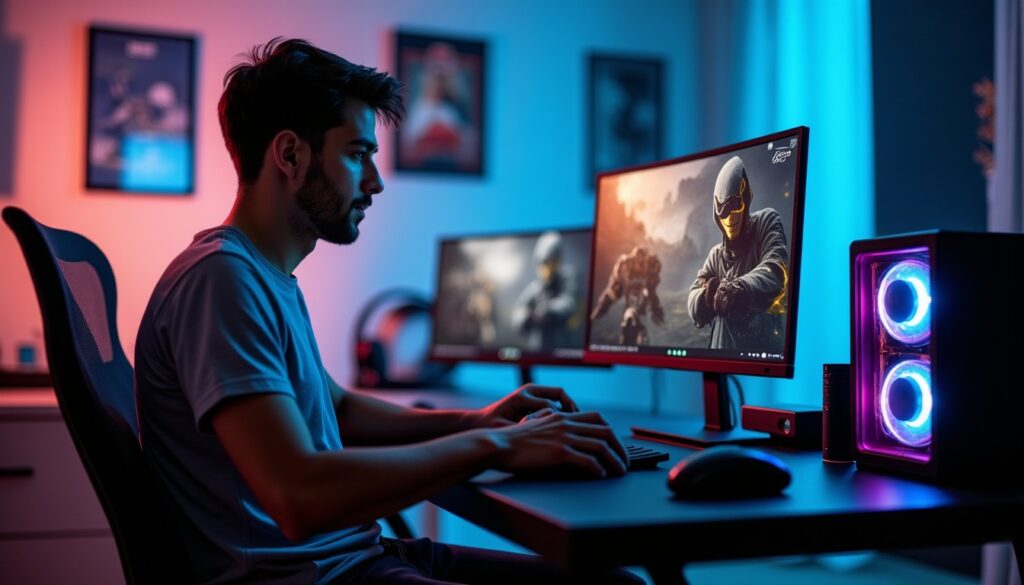
The world of video games evolves rapidly, and the dilemma between PC Gaming and Console took an interesting turn in 2026. For a long time, consoles dominated the market thanks to their simplicity and exclusive catalogs, while computers offered increased technical performance often at a higher cost. Today, this boundary is becoming blurred. Console performance is improving, but PC gaming remains the most versatile and powerful platform. Meanwhile, PC build prices are dropping, which prompts many players to ask the crucial question: when is it wise to take the leap and invest in a gaming PC? Between choices linked to performance, budget, gaming experience, or game catalog, we explore the essential criteria that will guide this jump to the computer.
Choosing between PC and console is no longer just about a simple logo on the box or the number of available games. The year 2026 marks a phase where gamers can truly weigh the technical, economic, and practical advantages of each platform. For example, a well-configured PC can now surpass the technical capabilities of a PlayStation 5, offering higher frame rates and resolutions. Yet, the console defends itself with ease of use and its attractive catalog of exclusives. Not to mention the social ecosystem and eSports, which have relied mostly on the PC for several years. In this context, understanding the key moments and motivations to switch to PC gaming proves essential, to avoid a rushed purchase and maximize long-term gaming pleasure.
Performance and FPS: why PC gaming pushes the limits
The very heart of the debate between PC Gaming and Console lies in the quest for superior performance and optimal gaming experience. In 2026, this reality has intensified with the emergence of PC configurations clearly capable of surpassing the technical ceilings of the latest consoles. A well-equipped computer can reach frame rates of over 144 FPS at 1440p resolution, a threshold still unreachable for many consoles. The PlayStation 5, for example, often limits itself to 120 FPS in 4K, but many titles remain capped at 60 FPS on ultra settings to ensure stability. This difference directly impacts the feeling of smoothness and responsiveness, especially in action games and FPS.
The refresh rate plays a crucial role. On PC, a screen with a rate of 144 Hz or even 240 Hz is common, guaranteeing exceptional smoothness in movements and more precise aiming. Consoles can rarely provide such a stable experience, with some games imposing limits due to optimization choices aimed at ensuring hardware compatibility. Thus, for competitive players and lovers of ultra-clear sensations, the PC is a true playground that makes a difference.
Beyond the simple FPS number, graphical scalability is a major asset of PC gaming. Unlike consoles, where one relies solely on presets defined by developers, the computer allows precise adjustment of every graphical setting. Whether you prefer to prioritize resolution, shadows, textures, or enable technologies like FreeSync, it is possible to optimize performance without sacrificing visual quality. This flexibility means a player can tailor their setup according to their preferences, hardware capabilities, and game requirements, to achieve a smooth and customized render.
This level of customization, the ability to adjust the platform to one’s playstyle and needs, explains why many professional players and eSports athletes favor the PC. This technical superiority has led to a gap that keeps widening, especially in game categories demanding quick reactions and graphic fluidity, creating a competitive advantage on the global scene.
Game catalog on PC: a diversity the console can’t match
The choice of a platform also strongly depends on the content accessible, and on this point, PC gaming offers unmatched diversity. Of course, consoles like PlayStation and Xbox maintain solid exclusives that attract millions of players. However, the PC hosts a vast number of titles you won’t find anywhere else. Enough to satisfy all profiles, from indie game lovers to avid online competition fans.
Firstly, PC’s strength lies in its community and digital ecosystem. Platforms like Steam, GOG, or Epic Games Store offer thousands of independent games that bring innovation, creativity, and originality far beyond what traditional console exclusives provide. These titles often have moderate prices, offer great replayability, and benefit from frequent updates.
Next, mobile games ported to PC expand the offerings with battlegrounds optimized for computers. Easy access to popular free-to-play games like Valorant, Counter-Strike 2, Dota 2, or League of Legends strengthens PC’s position as the preferred platform for online competitions. These games, available for free, rely on a huge global community and make the PC the main meeting place for players seeking to compete in eSports.
Finally, the computer provides a unique ability to integrate mods and community content. Skyrim, Minecraft, or many other popular hits have been completely transformed by players themselves, giving rise to unprecedented and often much more immersive experiences than the base version. This is a real advantage for those seeking personalization and longevity in their gaming experience.
Another important point: true backward compatibility. On PC, it is possible to find games decades old without any technical issues, thanks to emulators and adaptable configurations. This ability to freely access a catalog spanning multiple generations multiplies gaming possibilities and evolves the experience beyond mere novelty.
| Game type | Availability on PC | Availability on Console | PC Advantages |
|---|---|---|---|
| Independent games | Very many platforms, thousands of titles | Limited, a few exclusives | Affordable prices, creativity, variety |
| eSport Free-to-play games | Valorant, CS2, LoL, Dota 2, etc. | Fewer, often adapted | Better performance, active community |
| Mods and personalized content | Highly developed, extensive support | Almost nonexistent | Deep customization, replayability |
| AAA exclusives | Fewer PC exclusives | Halo, God of War, Final Fantasy | Optimized AAA quality depending on setup |
| Backward compatibility | 30+ year-old games compatible via emulation | Limited backward compatibility | Large historical library |
eSport advantage: why the competitive scene favors PC
eSports have exploded in popularity in recent years, gathering millions of spectators and generating audiences comparable to some traditional sports. Platform choice is fundamentally oriented toward PC gaming. Indeed, all major tournaments for competitive games like Counter-Strike 2, Valorant, or League of Legends take place exclusively on computer. This predominance is no coincidence and stems from the PC’s superior technical capabilities to guarantee an ultra-smooth and responsive experience, which is crucial in competitions where every millisecond counts.
The PC is also home to a particularly dynamic eSports community. Sponsors, publishers, and leagues invest massively in this platform, creating a thriving economic ecosystem around competitive gaming. This dynamic, in turn, attracts the best players and strengthens PC’s competitive advantage. Tournament formats are adapted to PC hardware constraints and its connectivity, offering the best visibility for commentators, fans, and media.
Beyond purely competitive aspects, the PC facilitates streaming and content creation around eSports thanks to its versatile hardware. A player can easily combine a passion for competitive gaming with live broadcasting, video editing, or coaching thanks to a powerful and customizable machine. It is no coincidence that many key figures in the video game world have chosen PC as their main platform.
Budget and total cost: the reality behind PC Gaming investment
The budget debate is often a sticking point for those hesitating to switch from console to computer. Yet, the reality is more nuanced than generally believed. In 2026, it is possible to build a solid gaming PC configuration for around 800 to 1,200 euros. This range allows comfortably enjoying titles in 1080p with more than 100 FPS, rivaling or even surpassing console experience quality.
Compared to buying a PlayStation 5 or Xbox Series X, along with games, online subscriptions (PlayStation Plus, Xbox Game Pass), and accessories, the PC can be less expensive over a 5-year period. Much of the long-term savings comes from regular promotions on platforms like Steam, where games are often discounted by 70% or 80%, drastically reducing catalog costs. This accessibility completely changes the perception of the gaming budget.
Moreover, a PC can serve multiple purposes: work, video editing, streaming, or software development, making it a versatile investment for the user. Even if the initial cost is sometimes higher, the utility value increases. Added to this is the possibility of upgrading hardware in stages. It is common to replace components (graphics card, processor, RAM) to keep up with new requirements, spreading expenditure over time.
Here is a list of points to consider in the overall budget for a player wishing to migrate to PC gaming:
- Purchase of the tower and components (graphics card, processor, RAM)
- Investment in the monitor (144Hz screen, 1440p or higher)
- Peripherals (mechanical keyboard, gaming mouse)
- Cost of games and subscriptions (several games offered during annual promotions)
- Electricity consumption and maintenance
- Additional accessories (headsets, gaming chairs, stands)
Note that the modular approach of the PC allows starting with a modest build and evolving according to the available budget, a luxury hardly achievable on console. This factor provides valuable financial flexibility, especially in a gaming world where technical novelties chain rapidly.
When to stay on console: advantages not to be overlooked
Despite the growing strengths of PC gaming, the console retains strong arguments that fully justify a player choosing to remain on this platform. First of all, the strength of exclusives remains a legitimate reason. Iconic franchises like God of War, Halo, or Final Fantasy continue to be must-plays that don’t always release on PC, or do so much later. For these licenses, the console often remains the mandatory gateway, offering an experience specifically designed for the platform.
Ease of use is another key factor. Plug-and-play operation – a single HDMI cable, a synchronized controller, immediate launch – remains a considerable advantage for those wanting quick and hassle-free access. No need for configurations or optimizations, which especially appeals to casual players or those who prefer simplicity.
Moreover, local couch multiplayer remains massively associated with consoles. The natural support for multiple controllers and split-screen features are often more developed and better integrated than on PC. For family or friend gatherings around the same console, this convivial experience remains a major asset.
In summary, some personal preferences, related to game choices, lifestyle, or desire for a simple setup, mean the console will not lose its audience anytime soon. Its accessibility, exclusive library, and local conviviality remain important pillars of the gaming experience.
Signs it’s time to switch to PC gaming
Switching from console to computer is not just a financial or technical question, it is above all a matter of aspiring to a new quality of gaming experience. Several clues can guide you to the ideal moment for taking the plunge:
- You regularly aim for 100+ FPS or play at 1440p resolution or higher, seeking maximum smoothness and image clarity.
- You want to invest in competitive games and eSports, as it is mainly on PC that these titles make full sense with better performance.
- You are curious or passionate about indie games and mods, a world where PC reigns due to its open and customizable nature.
- Your budget is flexible and you take advantage of frequent discounts on gaming platforms, maximizing your library at a lower cost.
- You combine your gaming activities with creative or technical work such as video editing, streaming, or development, looking for a single versatile machine.
When these criteria intersect in your profile, it becomes clear that the ideal moment to invest in a gaming PC has arrived. The transition then happens naturally, as the player immediately perceives the fundamental difference in experience offered by a tailor-made computer.
Optimal PC gaming setup: what to aim for in 2026
In 2026, an effective gaming PC setup must not only ensure raw performance but also provide a smooth and pleasant experience over time. Here are the main components to watch when choosing your future machine to optimize every euro spent.
The processor must be powerful enough not to limit graphics capabilities, especially in competitive games or complex simulations. Models like the latest Intel Core i5/i7 or AMD Ryzen 5/7 dominate the market, offering excellent value for money. The choice will also depend on whether you combine gaming with multimedia creation.
The graphics card is arguably the most crucial element. For a player who wants to fully exploit a 1440p screen at 144 Hz and exceed 100 FPS, a mid-to-high-end card from the NVIDIA RTX 4060/4070 series or AMD Radeon RX 7700 is recommended. The 2026 novelties guarantee smooth VRR (Variable Refresh Rate) rendering and advanced ray tracing support at a more affordable price.
As for RAM memory, 16 GB remains the standard for gaming, with the possibility of going up to 32 GB for intensive multitasking use. SSD storage is now essential for fast loading times, with a minimum of 1 TB recommended to hold current games that are often space-hungry.
Finally, the monitor is an extension of the setup. Essential, a 144 Hz screen with a minimum resolution of 1080p or even 1440p enhances the experience. FreeSync or G-Sync is advised to eliminate screen tearing and improve smoothness. The choice of size and panel type (IPS, VA) adapts to tastes and specific uses.
Investing in this setup guarantees that your PC will cope with future releases without requiring rushed upgrades. However, it is important to remember that upgradeability is a key advantage of PC, allowing continuous adaptation.
Gaming experience and personalized setups: the major asset of PC gaming
One of the greatest advantages of PC gaming compared to consoles lies in the advanced customization it offers. From optimizing graphical settings to ergonomic preferences, the player has the freedom to design an experience that reflects themselves. This phenomenon touches all aspects, from the user interface to in-game performance, including peripherals and connectivity.
For example, in the most recent video games, it is common to be able to individually adjust shadow quality, draw distance, lighting effects, or resolution. This allows compensating for possible hardware limitations by deprioritizing some graphic elements, thus providing perfect stability without sacrificing playability. This is particularly appreciated by competitive players who demand perfect responsiveness.
Beyond visual options, the PC allows a multitude of control configurations, from the traditional keyboard and mouse to specific controllers, racing wheels, or other peripherals suited to each playstyle. This freedom often comes with dedicated software allowing macro customization, shortcuts, or touch zones, always aiming at optimizing the experience.
Furthermore, multi-monitor setups or integration with streaming platforms make the PC environment particularly appealing to those wishing to share their experience or create content. Whether for solo gaming sessions or online tournaments, customized setups become an important lever to maximize satisfaction and performance.
In contrast, consoles remain fixed on their hardware and software, leaving little room for adjustment. This standardization tends to uniform the experience but not maximize it for the most demanding users, reinforcing the customizable superiority of PC gaming.