
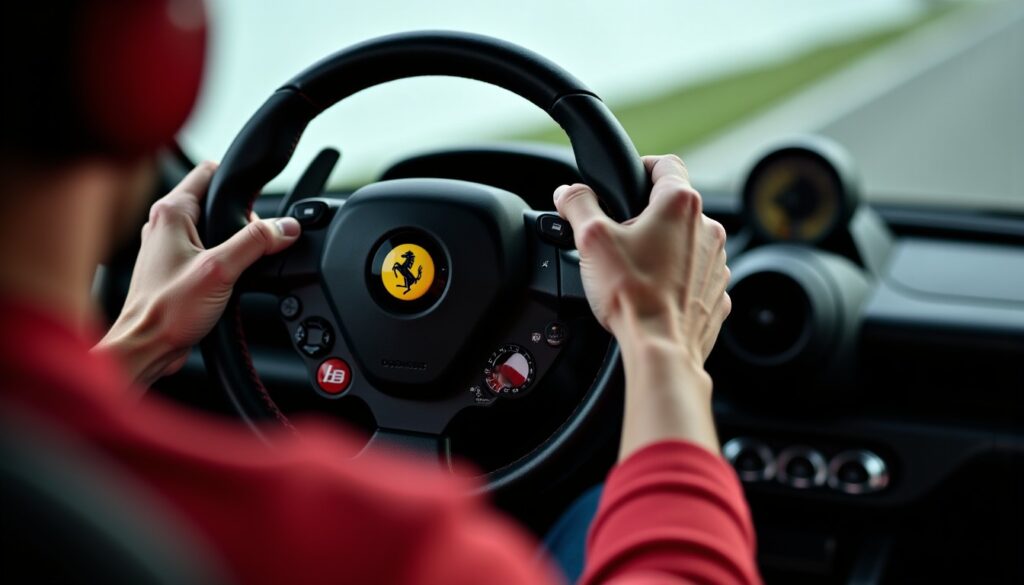
Car racing simulation experienced a revolution with the arrival of the Thrustmaster SF1000 steering wheel, a faithful and ambitious replica of the wheel used by the Scuderia Ferrari in Formula 1 during the 2020 season. Since its release, this high-end device has attracted both racing game enthusiasts and virtual driving amateurs seeking an immersive and realistic experience. Between authentic design, cutting-edge technologies, and broad compatibility, the SF1000 offers a unique immersion into the intense and precise world of Formula 1, with the iconic Ferrari touch. However, this sophistication does not come without questions, particularly regarding value for money and ergonomics in use.
In a context where sim racing equipment evolves more and more each year and where the fidelity of reproductions is a key criterion for serious players, it is essential to dissect the strengths and limitations of the SF1000. This comprehensive review aims to provide a detailed analysis, covering its aesthetics, technical characteristics, software integration, and compatibility with various market platforms. You will discover whether this steering wheel, at the crossroads of innovation and Ferrari tradition, deserves its place in your racing simulator setup in 2026.
The Thrustmaster SF1000 Edition is a feat in terms of design and manufacturing. This 1:1 scale replica of the Ferrari SF1000 steering wheel from the 2020 season stands out first and foremost for its extreme fidelity, which immediately plunges the user into the world of professional Formula 1. This authenticity is not limited to the visual aspect: every component was designed to reproduce the same feel as a Scuderia driver. The wheel measures exactly 28 cm in width and has total dimensions of 28 x 18 x 9.5 cm, guaranteeing a hand sensation close to reality.
What impresses first is the use of high-end carbon fiber for the central plate. Made of 21 layers of 3 mm thickness, it combines lightness and rigidity, ensuring robustness far from simple plastic wheels. This premium construction not only enhances the aesthetics, with a very neat and professional look, but also the product’s durability. At the same time, the textured rubber grips offer a solid grip, although their comfort may decrease during long sessions without gloves. Their surface, perfectly suited to racing gloves, encourages adopting this accessory for an optimal experience.
An impressive array of controls equips this steering wheel: it has 25 action buttons, 7 rotary encoders, and above all two pairs of 100% aluminum paddles with a push-pull function. This system allows upshifting or downshifting via either paddle, a detail that faithfully reflects the techniques used by F1 drivers. The analog clutch paddles offer a 25° travel, ideal for precise and controlled starts. Aside from a slight critique regarding their noise and somewhat rough finish, their responsiveness and robustness are appreciated.
Finally, another major strong point of this wheel is its integrated 4.3-inch color LCD screen, accompanied by 21 LEDs. It offers 6 display modes that retransmit telemetry in real time: ranging from tire wear status to engine temperature, including various mechanical data. This mini-console is a true revolution for racing games, transforming virtual driving into an experience both immersive and functional.
Embedded technologies for immersive and precise simulation
The SF1000 is not content with its appearance: it integrates advanced technologies that significantly improve the driving simulation experience. Among these, the precision of the analog paddles and the quality of haptic feedback are crucial. The aluminum gear shift paddles, thanks to their magnetic design with push-pull option, provide intuitive and smooth control, perfectly mimicking the real driving of a Ferrari F1 single-seater. This feature also allows downshifting or engaging the gear of choice without physically changing paddle — a practical innovation demonstrating intensive ergonomic research.
The integrated LCD screen revolutionizes data management during the race. Its 21 strategically placed LEDs allow quick visualization of crucial information, such as engine rev changes or the need to shift gears. Indeed, in high-level driving simulation, telemetry management is essential for adjusting one’s line and improving lap times. The display allows clear and intuitive reading, and the different modes adapt to several types of games and driving habits. This level of detail greatly enriches immersion.
In terms of sensations, the feel when driving with a 10 Nm turn-by-turn torque base is one of the SF1000’s major successes. Force feedback detects the circuit’s imperfections, micro-slips, and vibrations linked to the road surface with finesse. This tactile restitution helps refine driving mastery, allowing players to adjust their driving with surgical precision. However, it is advised to limit the motor power to about 80% to avoid unpleasant cracking noises that appear when maximum force is used during extended sessions. This advice came from early user feedback and has been widely confirmed in the 2026 setting optimizations.
Connecting the wheel to Thrustmaster T-Series bases is essential to fully exploit its potential. Whatever the platforms used — PC, PlayStation 4/5, or Xbox One/Series X|S — the SF1000 displays broad compatibility that will satisfy most drivers. However, it should be noted that the T818 Ferrari base, often offered with this wheel, only works with Windows, excluding console users. This slightly limits the SF1000’s versatility in some gaming environments, especially for multiplatform players looking to switch setups quickly.
Global compatibility and experiences on different gaming platforms
The Thrustmaster SF1000 was designed to reach a wide audience of players passionate about simulation and Formula 1 driving. To meet this ambition, Thrustmaster has carefully ensured as wide as possible multiplatform compatibility. In 2026, whether you are a PC user or a player on Sony or Microsoft consoles, this wheel fits perfectly into most setups, thanks to its support of the brand’s T-Series bases. Indeed, it operates smoothly on PlayStation 4 and 5 systems, as well as Xbox One and Xbox Series X|S, provided a compatible base has been acquired beforehand.
On the PC side, support under Windows 10 and beyond is smooth, with installation generally hassle-free. The wheel configures fairly easily via the Thrustmaster software, although the latter deserves some improvements, notably in managing game profiles and custom settings. Faced with this, dedicated third-party simulation software often takes over to optimize force curves, linearity, or paddle sensitivity. These complementary solutions meet the expectations of a demanding community that continues to develop its digital driving experience.
On consoles, most simulation titles support SF1000 inputs without issue, especially official Formula 1 games. However, it should be noted that some settings require repeated manual intervention, which can be tedious between gaming sessions. Unlike competitors like Fanatec, where saved profiles are directly accessible, Thrustmaster does not yet offer perfect integration to avoid such manipulations.
For players who want a rich and varied experience, the wheel also works perfectly with other popular racing games, even outside F1, demonstrating its versatility. This extended compatibility plays a decisive role in choosing a high-end wheel, offering the possibility to explore different driving styles and techniques.
Build quality and ergonomics: a tactile experience to refine
The ergonomics of the Thrustmaster SF1000 is a central point of its user experience. From the moment you hold it, the wheel conveys an impression of robustness and professionalism thanks to the materials used and the layout of the controls. All buttons have a very short travel, about 1 millimeter, with a firm spring that delivers an extremely reactive and precise sensation, ideal for demanding driving in a high-level racing game.
The rubberized grips initially promised good grip. However, after several hours of use, this coating tends to become somewhat sticky and causes discomfort, especially if you play without gloves. On the other hand, with racing gloves, this sensation disappears completely, and the wheel’s design, with its reduced diameter compared to older models, then becomes very comfortable and precise, naturally encouraging users to adopt this accessory for longer sessions.
The original paddles, although functional, drew some criticism due to their somewhat rough sound finish and the slight metallic noise they emit with each gear change. This minor but not negligible defect motivated users to turn to the optional “T-Chrono Paddles” accessory sold separately and recommended to improve sound and tactile quality. This module adds an extra cost of 55 to 60 euros, an additional expense to consider in the overall budget to obtain a truly professional feel.
The Quick Release, the fast wheel attachment system, is another key point. Although very practical for easily changing wheels, it adds nearly 7 cm to the overall depth and introduces a slight flex in the fixation, which can be disappointing for a product of this caliber and price.
Advanced features serving Formula 1 fidelity
The SF1000 also stands out for its desire to offer an ultra-realistic experience to Formula 1 enthusiasts, thanks to its attention to technical and ergonomic details. By adopting the structure and design of the official Ferrari SF1000 wheel, it allows players to benefit from a driving experience very close to that of professional drivers who raced the 2020 world championship circuits.
The buttons distributed on the wheel open a wide range of in-game possibilities, notably to manage race strategies, adjust car settings, or quickly access advanced features without taking eyes off the road. The rotary encoders, in particular, prove very useful to quickly modify parameters such as engine mapping or brake management.
This level of customization, rare on mid-range wheels, promotes dynamic and flexible driving. The possibility of using six different screen display modes enriches interactivity and allows each driver to adapt the information to their driving style or race priorities.
However, the Thrustmaster software still does not offer automatic profile management nor intuitive configuration saving between sessions. In 2026, this is a real shortcoming compared to the competition. Nevertheless, for key users, the intrinsic hardware quality requires forgiving this software lack, as the tactile feel and control finesse speak for themselves.
Detailed analysis of pricing and accessories: what you need to know before buying
A crucial element in evaluating the SF1000 is its value for money. With an official price set at €349.99 at release, the wheel positioned itself as a premium mid-range product. However, the 2026 market reality reflects a marked price volatility, notably due to strong demand and recurring stock shortages.
It is observed that reseller prices can vary from half to double, with prices ranging between €400 and over €750 on certain online platforms. This inflation naturally impacts aficionados and newcomers to car simulation, who must take this factor into account when purchasing.
Complementing the wheel, Thrustmaster offers several optional accessories to increase realism and functionality, starting with the previously mentioned T-Chrono paddles, essential for a silent and more pleasant experience. These equipments cost on average between 55 and 60 euros.
For those who want to push immersion even further, the complete T818 Ferrari SF1000 Simulator pack is also available, but it represents a significant investment, with a price exceeding €1,000. This pack includes the base, wheel, and other important simulation components, primarily targeting a professional or highly demanding passionate audience.
| Product / Accessory | Function | Approximate Price (2026) |
|---|---|---|
| Thrustmaster SF1000 Edition Wheel | Faithful replica of Ferrari F1 wheel, controls, LCD screen | €349.99 (varies by retailer) |
| T-Chrono Paddles | Improves tactile and sound quality of paddles | €55-60 |
| T818 Ferrari SF1000 Simulator Pack | Complete kit base + wheel + accessories | About €1,099 |
Thrustmaster software: a weak point for overall ergonomics
Despite all its hardware advantages, the SF1000 suffers from a persistent software weakness. The Thrustmaster application that comes with the wheel remains a black mark for many users. Its interface, considered outdated, lacks essential modern features such as force curve management, automatic saving of settings, and intelligent adaptation depending on the game launched.
This absence often forces drivers to manually reconfigure their wheel at the start of each session, which can become tiresome, especially for those who chain multiple titles or sessions in one day. With the democratization of saved user profiles and intuitive interfaces offered by renowned competitors, Thrustmaster appears somewhat behind, detracting from the smoothness of the overall experience.
However, the most expert users manage to circumvent these limitations through third-party solutions or manual custom settings, thus maximizing the intrinsic quality of the SF1000’s physical feedback. Overall, the hardware largely compensates for these software shortcomings, but this remains an essential area for Thrustmaster to improve in the coming years, especially against an increasingly demanding professional clientele.
Why the Thrustmaster SF1000 remains a must-have choice in the sim racing world
Beyond its imperfections, the SF1000 alone symbolizes the rise of sim racing and its anchoring in modern car culture. For many players, it offers a bridge between the virtual world and the authentic passion for Formula 1, made even stronger by the official collaboration with Ferrari. The extreme fidelity of the replica, the quality of its assembly, and the immersion provided thanks to its integrated LCD screen are undeniable arguments for considering it as one of the best mid-range wheels on the market in 2026.
Despite critiques about the software and some ergonomic details, its versatility across multiple platforms and excellence in conveying driving sensations make it a reliable choice for players wishing to fully immerse themselves in the intense immersive experience of a racing game. Finally, the possibility to extend its setup with complementary accessories guarantees advanced customization, suitable for all levels, from curious beginners to expert virtual drivers.
In summary, the Thrustmaster SF1000 embodies the idea that driving simulation can be accessible, authentic, and exciting. It therefore remains a must-study option, whether you are a lover of virtual circuits or a collector of high-fidelity simulation equipment.