
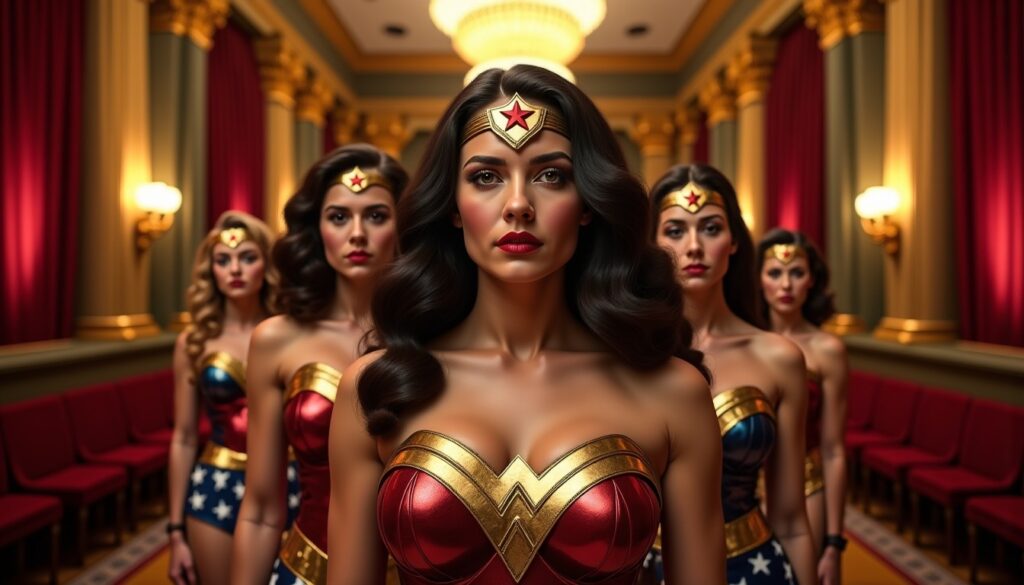
The character of Wonder Woman, an essential emblem of pop culture and superheroines, has spanned several decades captivating millions of fans. From her origins, this Amazon princess managed to infiltrate the collective imagination through her courage, values, and mythical aura. On the big and small screens, she has been portrayed by various actresses, each bringing their touch, charisma, and unique energy to breathe life into this demanding role. The costume, a reflection of her identity, has also become a symbol of female power through the ages. From 1970s television to the modern big screen, the character has evolved with her time, defying standards and embodying a universal message of justice and empowerment. This article offers you a journey through these multiple incarnations, revealing behind-the-scenes details, physical preparations, casting choices, as well as the cultural repercussions of each interpretation.
The question often asked among DC Comics and superhero enthusiasts is: who has truly brought Wonder Woman to life over the years? The answer can be found through a comprehensive gallery of actresses, from the first TV movie to the most recent productions. This exploration highlights not only their careers but also the technical and artistic challenges they overcame, without forgetting the impact of their performances on generations of viewers. For each actress, the costume is more than just a garment: it represents an identity, a legacy, a strength that spans scripts, sets, and eras.
The First Portrayals of Wonder Woman in Cinema and Television
The role of Wonder Woman in cinema began long before the modern era of blockbusters. In 1974, Cathy Lee Crosby had the heavy task of wearing the Diana Prince costume for the first time in a TV movie produced by ABC. This first appearance on screen laid the foundations of the character, even if the chosen adaptation diverged from the DC Comics canon. In this version, Wonder Woman is an undercover spy, which gave it a more realistic tone, closer to spy series of the time. Crosby’s approach marked a turning point, but it was not immediately followed by a sequel due to its distance from the original traits of the comics.
A few months later, the true modern icon was born with Lynda Carter. The American actress portrayed Diana Prince in the TV series “Wonder Woman,” which aired from 1975 to 1979. More than sixty episodes allowed her version of the character to root itself in popular imagination. Her rigorous interpretation, combined with a costume faithful to the model drawn in the comics — with the red bodice adorned with a golden eagle, the blue starry skirt, the lasso of truth, the bulletproof bracelets, and the golden tiara — made this Wonder Woman a symbol of strong and independent femininity of the 70s.
Beyond television popularity, Lynda Carter also helped standardize the character’s aesthetic for future decades. Her eloquence and posture influenced many actresses who would follow. Through her, Diana Prince embodied a feminist icon ahead of her time, sensitive to social issues while remaining an accessible heroine. This role also helped open the field to heroines in media, who had previously been often underrepresented. It is therefore at this time that Wonder Woman truly entered the legend of American television and cinema.
By drawing a portrait of live-action heroines of the 70s, one easily recognizes the privileged place Lynda Carter holds among superhero actresses. Her ability to combine strength and femininity allowed Wonder Woman to firmly anchor herself in pop culture.
Gal Gadot: From Miss Israel to Big Screen Icon
The major turning point in Wonder Woman’s cinematic history occurred with Gal Gadot, who became in just a few years the most identified figure worldwide for the role. Recruited in 2013 by Warner Bros., this former Miss Israel quickly transformed her image to meet the colossal demands of a modern superheroine within the DC Extended Universe (DCEU).
Her career is emblematic: Gal Gadot, born in Petah Tikva in 1985, already had an atypical profile for a Hollywood actress. After earning the Miss Israel title in 2004 and completing the compulsory military service in the Israeli armed forces where she served as a physical and combat instructor, she was able to combine discipline and charisma. This military experience proved a decisive asset when it came to engaging in the intensive physical training required to become Wonder Woman.
Gadot’s preparation was remarkable, with six months of daily training including two hours of kung-fu, kickboxing, and jiu-jitsu, two hours of fight choreography for action scenes, and two hours of horseback riding. This regimen was complemented by strict dietary control, necessary to maintain the pace of an exhausting shoot and precise aesthetic demands. This dedication marked both the public and critics, highlighting the fundamental physical expertise required to embody such a powerful character.
The role of Diana Prince/Captain Wonder Woman began with “Batman v Superman: Dawn of Justice” (2016), in which she made a notable appearance. Then the independent film “Wonder Woman” in 2017 was a major critical and commercial success, propelling Gadot to stardom. Directed by Patty Jenkins, this film managed to combine emotion, action, and respect for the original mythology, enriching the character with a depth rarely seen in female superhero adaptations.
The peculiarity of the shoot also lies in the fact that Gal Gadot was five months pregnant during the additional scenes at the end of 2016, a challenge met thanks to special effects in post-production. This anecdote clearly illustrates the meticulous work and often overlooked complexity of a blockbuster shoot.
Here is a summary table of the DC films in which Gal Gadot has portrayed Wonder Woman:
| Film | Year | Role |
|---|---|---|
| Batman v Superman: Dawn of Justice | 2016 | Diana Prince / Wonder Woman |
| Wonder Woman | 2017 | Wonder Woman |
| Justice League | 2017 | Wonder Woman |
| Wonder Woman 1984 | 2020 | Wonder Woman |
| Zack Snyder’s Justice League | 2021 | Wonder Woman |
| Shazam! Fury of the Gods | 2023 | Wonder Woman (cameo) |
| The Flash | 2023 | Wonder Woman |
Beyond the films, Gal Gadot has also drawn attention for her public engagement, even if this has sometimes sparked controversies, notably in several Arab countries where her opinions and military past led to the banning or deprogramming of her films. Despite everything, her portrayal remains a symbol of female emancipation and resilience in international superhero cinema.
Lynda Carter: The Timeless Television Reference
The 1970s decade was marked by a fresh breeze blowing through the representation of strong women on television. Lynda Carter is undoubtedly the most famous actress to have portrayed Diana Prince/Wonder Woman before the era of Hollywood blockbusters. With the series aired from 1975 to 1979, she challenged norms and offered a heroine combining grace, strength, and wisdom.
Through her iconic costumes — the red bodice adorned with a golden eagle, the dark blue skirt starred with gold, the bulletproof bracelets, and the tiara — she gave viewers a powerful and eloquent vision of the superheroine. This look, now iconic, is still today a strong source of inspiration for cosplayers, artists, and directors. The series included sixty episodes spread over three seasons, mixing adventures, puzzles, and social justice actions.
Lynda Carter is often cited as a feminist model for her role in this series. Her charisma and gentleness coupled with her determination helped break the mold of caricatured and superficial heroines. The TV production was a massive success, reaching multiple generations and leaving a lasting mark on the world of female superheroes on television.
In 2017, at the world premiere of the Wonder Woman film, Gal Gadot had the opportunity to meet this pioneer of the role, thus witnessing a profound link between generations of the character’s performers. This transmission illustrates how the character transcends eras, adapting to contexts while keeping her mythological and symbolic foundations.
Physical Preparation and Technical Challenges to Portray Wonder Woman
Portraying a character as mythical and powerful as Wonder Woman is not limited to wearing a sparkling costume. It involves exceptional physical and mental commitment, especially for modern film versions. Gal Gadot’s example perfectly illustrates this reality: six months of intensive preparation, combining martial arts, fight choreography, and horseback riding. These disciplines are essential to make every jump, every fight, and every parry of the Amazon warrior believable.
Beyond physical preparation, wearing the costume presents its own challenges. The traditional costume, while iconic, is often heavy, rigid, and uncomfortable. In recent productions, designers have sought to combine aesthetics and functionality, allowing the actress to move with agility and power. The lasso of truth and bulletproof bracelets are not just decorative accessories: they participate in the scene’s narrative, and their handling must be perfectly mastered.
Technology has also helped alleviate certain discomforts. For example, during the filming of additional scenes for the Wonder Woman movie in 2016, Gal Gadot’s pregnancy required the use of green screens. Her visible belly was erased in post-production, thus guaranteeing visual continuity for the character. This demonstrates the ingenuity of technical teams in balancing personal life and artistic demands.
Recently, productions have also focused on the symbolism of the costume. Every detail, every color is selected to reinforce the character’s psychology. For instance, red symbolizes passion and war, blue loyalty and wisdom, while gold illustrates divinity and justice. The costume thus becomes a true storytelling tool that transcends appearance to reveal the very nature of Diana Prince.
Wonder Woman in Animated Productions: Voices and Iconic Representations
Wonder Woman is not limited to live-action appearances. In the rich universe of DC Comics animated adaptations, several actresses have lent their voices to Diana Prince, further strengthening her popularity and cultural reach. Since 2001, Susan Eisenberg has been the most iconic voice of the Amazon princess in the “Justice League” and “Justice League Unlimited” series. Her performance deeply marked fans, giving both strength and emotional nuance to the character.
Alongside Eisenberg, Rosario Dawson has participated in voicing the character between 2015 and 2021 in several animated films. This vocal continuity ensures strong coherence in the character’s representation on screen, regardless of the format.
These animated universes offer a narrative freedom often inaccessible in large cinematic productions. Writers can explore alternative stories, different eras, without being limited by the budget constraints of special effects. This helps enrich Wonder Woman’s mythology, offering multiple versions closer or further from the original comics.
Thanks to these voice dubbings, Wonder Woman reaches a wider, often younger audience, introducing the superheroine to a new generation discovering both the values and battles she embodies. We thus observe how the Amazon princess remains a powerful figure beyond formats and generational boundaries.
Wonder Woman’s Costume: Symbolism and Evolution on Screen
Wonder Woman’s costume is undoubtedly one of the most recognizable in the world of superheroes. It is not just a garment but a powerful vector of messages and symbols. Since 1941, the costume design has undergone several evolutions while maintaining essential elements that identify the heroine: the red bodice, the blue starry skirt or pants, the bulletproof bracelets, the lasso of truth, and the golden tiara.
On 1970s television, Lynda Carter wore a costume fairly faithful to the original comic book, with a wealth of details emphasizing the character’s strength and femininity. This costume was both a style statement and a narrative tool.
With Gal Gadot’s arrival in cinema, the costume underwent modifications to make it more realistic and functional. The bodice now features a more warrior-like and modern design, while the short skirt is replaced in some scenes by pants or full armor. These visual adjustments strengthen Diana’s credibility and power, taking into account contemporary aesthetic demands.
The costume also serves to underline the character’s precise mythological roots, inspired by traditional Greek armor. This historical dimension adds additional weight to Wonder Woman’s image, anchored in an ancestral culture while evolving in a futuristic universe.
This duality of the costume, between tradition and modernity, perfectly reflects the evolution of the female role in society, symbolizing a woman both timeless and resolutely forward-looking. The costume remains one of the key elements that make Wonder Woman recognizable and admired on all screens.
Supporting Actresses and Cameos That Enriched Wonder Woman’s History in Cinema
While the lead actresses have marked Wonder Woman’s history, several actresses have also helped to enrich the Amazon warrior’s universe, notably through cameos and supporting roles. In some DC films, actresses have dubbed Wonder Woman in flashbacks, animated sequences, or lent their voices for dubbing scenes.
Notably, in the film “Shazam! Fury of the Gods” (2023), Gal Gadot made a remarkable appearance, introducing her character into an extended universe and connecting the different DC franchises. These appearances strengthen narrative cohesion and create a sense of universality around her role.
It is not uncommon for experienced actresses to be called upon to dub Wonder Woman’s voice in various audiovisual productions, sometimes in the original version and sometimes in French. In France, Ingrid Donnadieu is now recognized for lending her voice to Gal Gadot in these dubbings, contributing to the audience’s immersion in this modern superheroine.
These supporting roles, although sometimes discreet, hold key importance. They help build a rich and coherent universe where every detail counts. They also fuel fascination for Wonder Woman by highlighting the variety of her representations and the complexity of the character on screen.
Awards and Controversies Surrounding Wonder Woman in Cinema
Wonder Woman, in addition to her major cultural impact, has also been at the center of several critical distinctions and sociopolitical debates. For her portrayal, Gal Gadot has received numerous awards, including the Saturn Award for Best Actress in 2018, as well as two Teen Choice Awards in 2017. These distinctions attest to the quality of her performance and the importance of the character in contemporary film industry.
However, the character’s popularity has not been without controversy. The film “Wonder Woman” was censored or banned in several Arab countries — including Lebanon, Tunisia, Algeria, and Qatar — mainly because of the actress’s military past and her public positions. This context raises broader reflection on how a superheroine can transcend cultural boundaries while remaining linked to a sometimes contentious political universe.
These tensions also underline that Wonder Woman is much more than a fictional character: she acts as a vector of identities and contemporary conflicts. Her representation in cinema becomes a platform to discuss the place of women in society, international politics, and media. It is this multidimensional complexity that fuels the ongoing interest in this character.
By analyzing the awards and controversies, we understand that Wonder Woman is a cultural phenomenon that goes beyond mere entertainment, embodying values that still resonate today and will undoubtedly provoke tomorrow’s debates.